
A CQC Outstanding rating means a care service has been judged to perform exceptionally well. For families, it is a strong sign of quality, but it should never be the only thing you check. The best choice still comes from reading the latest CQC inspection report, visiting the care home, asking direct questions, and seeing how residents are treated day to day. In this article, we explore what a CQC Outstanding rating means, how CQC ratings work, and how families can use inspection reports when comparing care homes in West Sussex.
What Does CQC Outstanding Mean?
What does CQC Outstanding mean when you see it beside a care home? In plain English, it means the Care Quality Commission believes the service is performing exceptionally well. It is the highest rating CQC gives in England.
That sounds simple enough, but families often need more than a label. A parent may need residential care. A loved one may need dementia support. A short respite stay may have turned into a bigger conversation about long-term care. At that point, the real question is not just what the rating means, but what it means for safety, dignity, comfort, routine, food, activities, leadership and the small daily details that make a care home feel kind.
For families comparing care homes in Felpham, Bognor Regis, Littlehampton or nearby West Sussex towns, a CQC rating is often the first trust signal. But it should sit alongside a visit, recent reviews, staff conversations, care needs, location and whether the home feels genuinely comfortable for your loved one.
The Care Quality Commission is the independent regulator of health and adult social care in England. It registers, checks and rates services, including care homes, home-care agencies, GP practices and hospitals.
In practical terms, a CQC Outstanding rating means inspectors found strong evidence that a service goes beyond basic compliance. It is not only “good enough.” It points to care that stands out because people are safe, listened to, respected and supported to live with as much choice and comfort as possible.
CQC Meaning: Who Checks Care Homes in England?
CQC stands for the Care Quality Commission. It applies to England, not Scotland, Wales or Northern Ireland. That matters because people sometimes search for Care Commission Scotland or Scotland CQC, but Scotland has a different regulator, the Care Inspectorate.
For England, CQC care homes are checked against a national inspection framework. The aim is to judge whether people receive safe, effective, compassionate and well-led care. CQC reports on care homes are public, which means families can use the CQC website to search for a service, compare care home ratings and read what inspectors found.
This is helpful, but here’s the thing. The CQC rating is only the start. A care home might have a strong rating, but you still need to check whether it suits your loved one’s needs, personality and daily routine. That is where visits, family reviews and honest questions make all the difference.
CQC Ratings and What Each One Means
CQC ratings help families understand quality at a glance. They are not perfect, and they are not a replacement for seeing the home yourself, but they do give you a reliable first filter.
| CQC Rating | What It Means | What Families Should Do Next |
| Outstanding | The service is performing exceptionally well. | Read the full inspection report and check which areas were rated Outstanding. |
| Good | The service is performing well and meeting expectations. | Treat it as a positive rating, then visit and ask about care plans, staff support and daily life. |
| Requires Improvement | The service is not performing as well as it should. | Read the concerns closely and ask what has changed since the report. |
| Inadequate | The service is performing badly, and CQC has taken action. | Be very cautious and seek updated evidence before you consider the service. |
In newer CQC assessment reports, ratings can also link to a percentage score. CQC says 88% to 100% sits in the Outstanding band, 63% to 87% is Good, 39% to 62% is Requires Improvement, and 38% or lower is Inadequate.
That extra score can help because a service may sit near the top or bottom of a rating band. Still, the headline label never tells the full story. Always check the date of the latest inspection report, the details behind the rating and whether the home has had any more recent updates.
A CQC Outstanding rating is the highest rating available, but families should also understand what a Good rating means, how recent the report is, and how the home feels during a visit. This is especially important when you compare Oakland Court and Oakland Grange, because families should check each home’s latest CQC report before making any care decision.
How CQC Decides if Care Is Outstanding
CQC inspectors do not judge a care home by first impressions alone. They look at records, speak with people who use the service, talk to relatives and staff, observe care, review safety systems and consider wider evidence.
CQC uses five key questions to shape its assessment. These are often called the CQC 5 standards, although CQC now talks more about five key questions and quality statements.
| CQC Key Question | What It Looks At | What It Means in a Care Home |
| Safe | Protection from abuse and avoidable harm. | Medication, falls prevention, safeguarding, staffing and risk plans are handled well. |
| Effective | Care, treatment and support lead to good outcomes. | Staff have the right skills, residents eat and drink well, and care supports quality of life. |
| Caring | People are treated with kindness, dignity and respect. | Staff know residents as individuals, not tasks on a rota. |
| Responsive | Services meet people’s needs. | Care plans reflect routines, culture, hobbies, communication needs and family input. |
| Well-led | Leadership and governance support high-quality care. | Managers listen, learn, act on feedback and create a fair, open culture. |
For families, this matters because a care home should not be judged on décor alone. A smart lounge and a fresh coat of paint are nice, of course, but they do not prove safe medication systems, skilled staff, thoughtful care plans or good leadership.
A strong CQC inspection report should show how the home protects residents, supports independence, responds to concerns and helps people enjoy daily life. It should also show whether leaders learn from feedback instead of brushing it aside.
What Outstanding Care Looks Like Day to Day
Outstanding care is not only a rating on a poster. It should be visible in the rhythm of the home. A resident is not rushed through breakfast. Staff remember how someone likes their tea. A person with dementia is helped to feel calm, not corrected every time they forget. Families are kept informed without having to chase. Activities are not just there to fill a timetable; they match real interests and help people feel part of the home.
CQC’s own work on outstanding care says “Outstanding care is always highly responsive to individuals’ needs, preferences and aspirations” in its guidance on what makes care outstanding. That line matters because it shifts the focus from box-ticking to the person.
A genuinely strong care home does not only ask, “Is the resident safe?” It asks, “What still makes life feel like theirs?” That may mean helping someone keep a morning routine, enjoy a favourite meal, join a garden activity, speak with family, or bring familiar furniture into their room.
That is where Oakland Care Group’s “home, not just a care home” style fits the topic well. The best care is not cold or clinical. It protects people, yes, but it also gives them warmth, familiarity and a reason to enjoy the day.
Outstanding CQC Rating vs CQC Good Rating
It is easy to think that good is not good enough because Outstanding is higher. That is not fair. A CQC Good rating means the service is performing well and meeting expectations. For many families, a Good-rated care home can still be safe, kind, stable and well-suited to their loved one.
The difference is that Outstanding means the service has shown something exceptional. That could be unusually strong leadership, excellent personalised care, better-than-usual resident outcomes, creative activities, close work with families, or a culture where staff go beyond routine care.
If you are comparing homes in West Sussex, it can help to read both the general guidance on what a CQC rating means and the specific guidance on what a CQC Good rating means. That way, you avoid a black-and-white view of care home ratings.
| Question Families Ask | Why It Matters | What to Check |
| Is Outstanding always better than Good? | Usually, but the latest report date and your loved one’s needs still matter. | Compare the newest inspection report, not just the headline rating. |
| Can a Good care home still provide excellent care? | Yes. Good means the home is performing well and meeting expectations. | Visit, meet staff and ask about person-centred care. |
| Should I avoid Requires Improvement? | Not always, but you need clear evidence of progress. | Ask what the CQC wanted improved and what has changed since. |
| Does a CQC rating replace family judgment? | No. It is one important signal among several. | Read reviews, visit and watch how staff speak with residents. |
If you are early in your search, understanding how to choose a care home in the UK can help you build a practical checklist before you book visits.
How Families in West Sussex Should Use a CQC Rating
For families in Bognor Regis, Felpham, Littlehampton, Chichester, Selsey, Barnham, Yapton, Angmering, Worthing or nearby West Sussex towns, location can be more than a postcode. It can affect how often relatives visit, how quickly the family can respond, and how settled a person feels after the move.
A CQC rating helps you narrow the search, but it should not be the only deciding factor. Use it beside three other checks: the latest inspection report, the care home visit and your loved one’s personal needs.
If your parent feels anxious in large settings, a smaller, homely environment may matter more than a glossy brochure. If they enjoy the coast, gardens or quiet routines, the setting may make daily life easier. If they need short-term support after illness or a family carer needs rest, respite care may be the best first step.
Oakland Care Group’s two West Sussex homes give families a local option to compare. Oakland Court is based in Felpham, near Bognor Regis, while Oakland Grange is in Littlehampton. Both should be considered through the same careful process: read the latest CQC report, review recent reviews, visit the home, meet the team, and ask whether the care can meet your loved one’s needs.
For local research, you can also refer to information on care homes near Bognor Regis, Felpham, and Littlehampton.
How to Read a CQC Inspection Report Properly
A CQC inspection report can feel a little dry, but it is worth the time. Do not stop at the CQC logo or the rating poster. Open the full inspection report and read the summary first. Then look at each key question.
Start with Safe. Families often worry about avoidable harm, falls, medication, infection control, staffing and safeguarding. If the Safe section is strong, that is reassuring. If it is weak, read carefully before you go further.
Then read Caring and Responsive. These sections often show whether the home knows residents as people. Look for words such as dignity, respect, choices, communication, activities, preferences, relatives and individual needs.
The Well-led section can be one of the most useful parts of a report. Good care rarely lasts without good leadership. If managers learn from incidents, act on feedback, support staff and keep clear records, the home is more likely to provide stable care.
You can use the CQC search to look up care homes by name or postcode. Once you find the right service, open the latest report, check the date and read the evidence behind the rating. After that, compare the report with family reviews, the home’s own information and what you see during a visit.
What CQC Ratings Mean for Residential Care
For a residential care home, a strong CQC rating should show that people receive safe support and a good quality of life. It should also show that staff understand personal care needs, risk plans, dignity, food and drink, activities, privacy and family contact.
Some families search for nursing home ratings or CQC nursing home ratings, especially when a loved one has more complex health needs. That is understandable. But not every care home is a nursing home, and the difference matters. A residential care home supports daily living and personal care. A nursing home usually provides care from registered nurses for more complex clinical needs.
Because Oakland Care Group is positioned around residential care, respite care, day care and older-adult support. Families should always check the care type, the latest CQC registration details and the home’s own team before they decide.
If your loved one needs residential care, ask about daily routine, meals, companionship, activities, staff availability, family visits and how care plans are reviewed. If they need nursing care, ask whether registered nursing support is available and whether the home is suitable for that level of need.
For a helpful comparison, information on care homes vs nursing homes can help you understand the difference before contacting any provider.
CQC Complaints, Concerns and Reporting a Care Home
CQC complaints can confuse families. The Care Quality Commission wants to hear about poor care, but it does not usually investigate individual complaints for you or resolve them on your behalf. To make a formal complaint, you normally start with the care provider or the organisation that pays for the care.
That said, you can still tell CQC about concerns. CQC reporting helps inspectors build a picture of risk across a service. If several families raise similar issues, that information may influence future inspection activity.
If there is immediate danger, call emergency services. If you are worried about abuse, neglect or serious risk in a care home, contact the local council safeguarding team as well as the care provider. For unresolved adult social care complaints, the Local Government and Social Care Ombudsman may be the next route after the provider or council has had the chance to respond.
The simple rule is this: raise concerns early, keep records and do not wait if someone is unsafe. A good care home should welcome concerns as a chance to put things right, not treat them as a nuisance.
What Families Should Ask When a Home Has a Strong CQC Rating
If a care home has a strong rating, that is a good start. But you still need to ask good questions. Ratings can age. Managers can change. Staff teams can grow or shrink. A positive report does not remove the need to see the home yourself.
Ask when the last CQC inspection took place. Ask which areas were rated strongest. Ask what the home has done since the inspection to maintain standards. Ask how families are kept updated. Ask how care plans are reviewed. Ask how the home supports residents who have dementia, anxiety, reduced mobility or changing health needs.
You should also ask what happens when things go wrong. No service is perfect. The better test is how openly staff respond to incidents, concerns and complaints. A defensive answer is a red flag. A clear answer that explains learning, action and communication is much more reassuring.
If you are unsure what to ask during a visit, use Oakland’s guidance on questions to ask when visiting a care home. It helps you move beyond décor and focus on care, safety and daily life.
Why Outstanding Is Rare, and Why That Matters
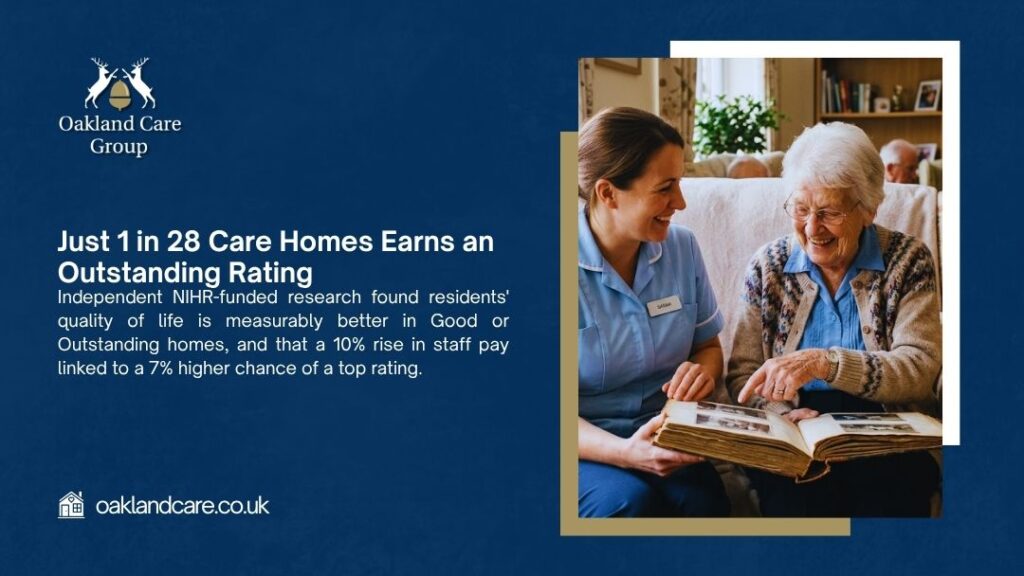
Outstanding CQC care homes are not the norm. Most care homes are rated Good rather than Outstanding, which is why the highest rating attracts attention. That rarity is part of its value, but it can also make families over-focus on one word.
A home does not need to be rated Outstanding to be right for your loved one. It does need to be safe, honest, well-led and suitable for the person’s needs. Sometimes, a local Good-rated care home with familiar surroundings, regular family visits and warm staff may be a better fit than a distant Outstanding home that feels less personal.
That is why families should keep the rating in perspective. It is one signal. The real decision also depends on whether your loved one feels comfortable, whether the care team listens and whether the home can support their needs now and as those needs change.
How CQC Ratings Fit With Reviews, Visits and Family Instinct
CQC ratings are independent, but they are not the whole picture. Care home reviews and family testimonials can add useful lived experience. So can visit at different times of day.
When you visit, pay attention to the atmosphere. Are residents relaxed? Do staff speak warmly? Are call bells answered? Does the home smell clean? Are meals calm or rushed? Are people left alone for long stretches? Are staff able to explain care plans clearly?
Also, check whether the home encourages family involvement. A good care home should not make relatives feel like visitors to a closed system. It should welcome questions and make it easy to raise concerns.
For a fuller decision process, read about what to look for when choosing a care home and how to compare care homes. These guides sit neatly beside CQC reports because they bring the rating into real family decision-making.

What Does CQC Outstanding Mean in 2026?
In 2026, a CQC Outstanding rating still means the service is judged to perform exceptionally well. It means inspectors found strong evidence across the CQC rating scale and the five key questions. It also means the service has shown more than basic compliance.
But families in 2026 are right to be careful. Care services change. Reports can become dated. Staffing pressure, leadership changes and local demand can affect quality. So treat an Outstanding rating as a powerful sign, not a blank cheque.
The best approach is balanced. Read the CQC report. Check the date. Compare the rating with recent reviews. Visit the home. Ask direct questions. Look at how residents live, not only how the home presents itself.
If you are helping a parent move into care, you may also find it useful to read about moving a parent into a care home or the emotional side of the guilt of putting a parent in a care home. These decisions are rarely just practical. They are personal and often heavy.
FAQs About CQC Outstanding Ratings
Is CQC Outstanding the best rating?
Yes. Outstanding is the highest CQC rating in England and means the service is performing exceptionally well.
Does a Good CQC rating mean a care home is safe?
A Good rating means the service is performing well and meeting CQC expectations, but families should still read the report and visit the home.
Can a care home lose an Outstanding rating?
Yes. Ratings can change after future inspections or assessments, so always check the latest CQC report.
Should I choose a care home only because it is Outstanding?
No. The rating matters, but your loved one’s needs, the home’s atmosphere, location, recent reviews and staff approach matter too.
How do I check a care home’s CQC rating?
Search the care home name or postcode on the CQC website, then open the latest report and rating details.
A Clear Way to Use CQC Ratings
A CQC Outstanding rating tells you, “Look closely, this service has shown exceptional quality.” It does not tell you to stop asking questions.
Use the rating as your first filter. Use the inspection report as your evidence. Use the visit as your reality check. Use family reviews as extra context. Then ask yourself one final question: would my loved one feel safe, respected and at home here? For many families, that is the real test.
If you are comparing care homes in West Sussex, start with the CQC rating, then look at the home itself. Oakland Care Group’s values focus on warm, person-centred care, dignity and a homely setting. You can learn more about the group’s approach through its care values or browse the wider care advice hub before you arrange a visit.
To take the next step, compare Oakland Court and Oakland Grange, read the latest CQC report for each home, then arrange a visit with the Oakland Care Group team. A rating can guide you. A report can inform you. But the right care home should also give you something more human: confidence that your loved one will be known, heard and cared for with patience.
