
Choosing a care home is one of those decisions where small details can carry huge consequences. This guide shows you exactly what to look for when choosing a care home, from care fit and CQC evidence to staffing, safety culture, daily life, and fee terms. It also gives you a clear way to compare homes so you can stop second-guessing and move forward with confidence.
What to look for when choosing a care home
What to look for when choosing a care home starts with one uncomfortable truth: you’re not choosing a building, you’re choosing a system. A care home can look spotless at 2 pm and still struggle at 2 am. What to look for when choosing a care home, then, is evidence that the system holds up when nobody’s watching.
The simplest way to keep your head is to split what to look for when choosing a care home into four layers. First, care fit, meaning the home can meet needs today and adapt tomorrow. Second, safety and clinical competence, meaning the basics never slip. Third, daily life and dignity, meaning it still feels like living. Fourth, money and terms, meaning the contract won’t ambush you later. That’s how to choose a care home without getting dazzled by décor.
Begin with a care needs assessment, not guesswork
If you’re in England, your local council can carry out a needs assessment under the Care and support statutory guidance to work out what care and support is required, and that assessment shapes what a suitable care home looks like. NHS guidance also points families toward adult social care services when they need help finding options and deciding what’s appropriate.
This matters because choosing a care home depends on whether the person needs personal care only, nursing care with qualified nurses on duty, dementia support, or something in between.
Plenty of stress comes from choosing the wrong type of care home, then needing another move later. If you’re trying to avoid that, what to look for when choosing a care home is a provider that can explain, calmly and clearly, what they can deliver now and what happens if needs change.
If you’re also comparing care in the home UK options, remember you’re weighing two different experiences. Home care can protect routine and familiarity, but a care home can offer 24-hour support, immediate response, and social contact that’s hard to replicate.
People are encouraged to consider their options carefully before moving into a care home, as it’s a major housing decision rather than just a service purchase.
Care home vs nursing home vs home care
It’s a good idea to settle this early, because what to look for when choosing a care home changes based on the level of care and support required. Once you match the type of care home to the care needs assessment, your shortlist gets cleaner, and your visits become far more useful.
| Option | What it usually provides | Best fit for | What to watch |
| Care home (residential) | Accommodation plus personal care, such as help with washing, dressing, meals, and mobility | People who need day-to-day support but not regular clinical nursing oversight | Ask how they handle changes in health needs, and whether moving again may be required |
| Nursing home | Everything a care home provides, plus nursing care led by qualified nurses | People with complex health needs, higher medical risk, or frequent clinical monitoring | Ask about night cover, medicine management, and escalation to GP/urgent care |
| Home care (care in the home UK) | Care visits at home, which may range from short daily support to more intensive packages | People who want to stay at home and can do so safely with the right plan | Gaps between visits, night-time safety, isolation, and whether 24-hour cover is realistic |
Here’s what I found: families who skip this comparison often end up viewing the “wrong” places and wasting time, which adds stress when decisions already feel heavy. Once you’ve nailed the right route, what to look for when choosing a care home becomes much easier to judge.
Quality checks that actually matter
What to look for when choosing a care home is easiest to judge through an independent lens. In England, the CQC inspects against five questions: is the service safe, effective, caring, responsive, and well-led? CQC also explains what people should be able to expect from a good care home under those headings.
Here’s what to look for when choosing a care home when you read those reports. Don’t stop at the headline rating. Look for how the home handles safeguarding, staffing adequacy, medicines, and person-centred planning. A Good home with repeated medication issues is not the same as a Good home with strong governance and stable leadership.
A guide pushes families to look at first impressions, staffing, and the practicalities of fees and complaints procedures during visits, and it provides a downloadable checklist for tours. That’s not busywork; it’s a way to stay objective when emotions run high.
Advice from official care authorities also anchors the decision in location, services, costs, and the rules around visiting and leaving the home. Those simple factors are not small. They shape whether the person remains connected to family or friends, and whether the home supports independence rather than quietly restricting it.
The viewing day playbook that makes your visit useful
What to look for when choosing a care home on a tour is not a script; it’s a set of cues. You’re watching how staff speak to residents, how residents respond, and whether the place feels calm for the right reasons.
The checklist covers the basics of what to look for when choosing a care home during a visit, from first impressions and bedroom comfort to staff, fees, visitors, and gardens. It’s long, but that length reflects reality: small details add up to quality of life.
Another key angle is complaints and feedback. Ask how the home encourages feedback, whether families are involved, and whether the manager is accessible. If you’re choosing a care home and the manager feels like a ghost, that’s not a small thing.
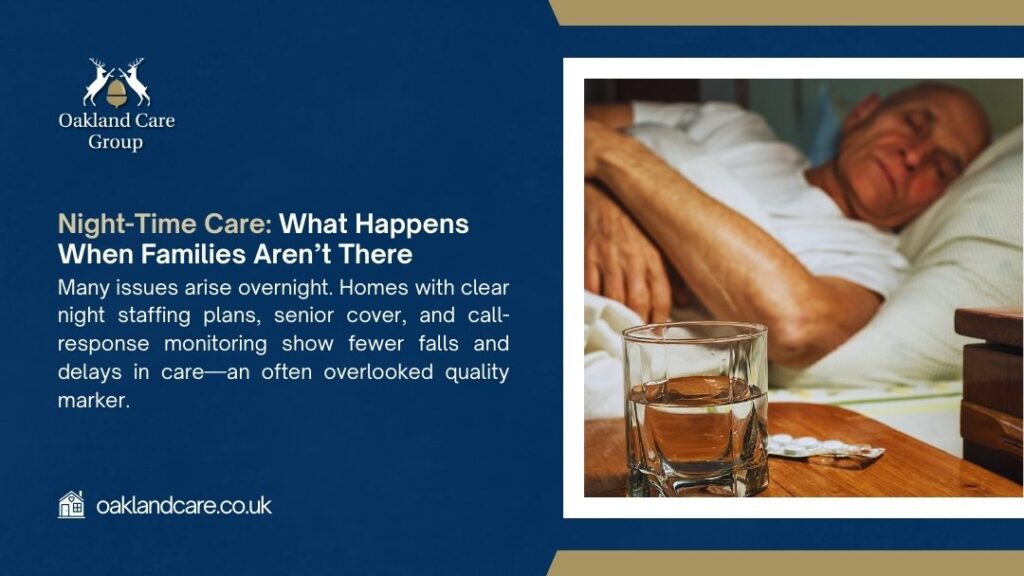
What to look for when choosing a care home also includes how the home behaves with transparency. Ask for sample menus, activity calendars, and the care plan process. Ask how they handle night-time checks. Ask how they prevent falls. Ask how they manage hydration and weight loss. A confident home answers without getting defensive.
Tour questions that reveal quality fast
| Area | What to ask (and why it matters) | What a strong answer sounds like |
| Staffing | “What’s the staff mix day and night, and who leads overnight?” | Specific ratios, clear senior cover, no hand-waving |
| Nursing care | “Are qualified nurses on site, and how do they coordinate with the GP?” | Clear clinical pathway and escalation process |
| Dementia support | “How do you reduce distress and support meaningful routine?” | Person-centred detail, not generic reassurance |
| Medicines | “Who administers meds and how are errors reviewed?” | Audits, training, learning culture, not blame |
| Safeguarding | “How do you report concerns and protect residents from abuse or financial harm?” | Clear policy, staff training, confident reporting route |
| Daily life | “How do residents keep choice over wake times, meals, and hobbies?” | Real examples, flexible routines, resident voice |
Staffing, safety, and clinical governance
What to look for when choosing a care home includes the boring operational stuff because that’s where outcomes live. The adult social care workforce in England has faced vacancy pressure, though recent reporting for 2024/25 shows the vacancy rate fell to 7% with 111,000 vacant posts, alongside growth in filled posts. Stable staffing improves continuity, and continuity improves safety.
So what to look for when choosing a care home is not only friendliness, but stability. Ask how long key staff have been there. Ask how agency use is managed. Ask about training, including dementia training if relevant. If your loved one needs nursing care, ask about nursing leadership and clinical supervision.
Safe and effective expectations permit you to ask direct questions. A good care home should keep equipment maintained, ensure there are enough skilled staff, and protect residents from harm, including financial abuse.
Daily life, dignity, and personal choice
What to look for when choosing a care home is also whether the person can keep being themselves. Meals, privacy, visitors, faith, hobbies, and the ability to go out safely are not luxuries; they’re mental health.
When people search “comfort care homes,” they’re often describing this layer: not just safety, but ease. A home can be clinically competent yet emotionally bleak. Ask whether residents can personalise rooms, whether staff know residents’ life stories, and whether there are activities that match actual interests rather than generic time-fillers.
For example, if the person’s social world is in West Sussex, choosing a care home near family helps visits stay frequent. A practical point often overlooked is that the best home is not always the nearest, but transport links and connections matter, and it encourages families to ask what support exists for staying in touch.
Costs, contracts, and who pays
What to look for when choosing a care home includes cost realism. In England, councils can help pay for care if savings are below the upper capital limit, which is set at £23,250.
National statistics reported that the average cost of a week of residential or nursing care increased to £1,185.55 in 2024/25 in England’s adult social care finance data. That figure is not what every family pays, but it frames why budgeting, fee clarity, and contract terms matter.
The checklist prompts questions about fee structure, deposits, annual reviews, and whether extra services sit outside the basic fee. That’s exactly what to look for when choosing a care home if you want fewer surprises later.
When you see average cost of care home uk and cost of a care home uk searches spike, it’s usually because families fear the same thing: money running out mid-placement. Your safest move is to understand what’s included, what is charged as an extra, and what happens if care needs rise.
A Simple Comparison table to compare homes
Before you leave a visit, it helps to turn impressions into something concrete. This simple comparison table lets you score each care home fairly, using the same criteria every time, so decisions are based on evidence rather than instinct alone.
| Comparison area | Home A | Home B | Home C |
| CQC rating and inspection themes | |||
| Care type matches assessed needs | |||
| Staffing stability and night cover | |||
| Nursing care availability (if needed) | |||
| Medication and safety management | |||
| Cleanliness, calmness, and atmosphere | |||
| Respect, dignity, and personal choice | |||
| Care Home Activities and social engagement | |||
| Family involvement and communication | |||
| Location and ease of visiting | |||
| Weekly fees and what’s included | |||
| Transparency around future cost rises |
Once you’ve filled this in, patterns usually emerge fast. What to look for when choosing a care home becomes clearer when one option consistently delivers across care quality, safety, and daily life rather than shining in just one area.

Conclusion:
What to look for when choosing a care home is not one thing, and it’s definitely not just the lobby. What to look for when choosing a care home is care fit, staffing stability, safety culture, and a daily routine that still respects the person. What to look for when choosing a care home is also the paperwork: fees, extras, contract terms, and a plan for what happens if needs rise.
If you want to choose well, pick two or three homes, tour them with a consistent set of questions, read the CQC report with the five-question lens, and follow the NHS pathway if you need local council support. Then commit. Second-guessing forever feels responsible, but it usually just drains everyone.
If you’re researching, choose the Oakland Care Group, then book a visit and bring your questions. A good home won’t flinch when you ask the hard stuff. And that’s why it matters.
