
Moving a parent, partner or close relative into residential care is one of the hardest decisions a family makes, and the weeks that follow can feel just as uncertain. If you are counting the days and asking how long does it take to settle into a care home, the honest answer brings some relief: most people do settle, and there is a recognisable pattern to how it happens.
What this article covers:
- The headline answer: most people, 4-8 weeks, with fuller adjustment often 1-3 months
- A week-by-week look at the settling-in period, from the first few days to feeling at home
- How dementia and memory care change the timeline
- The factors that speed up or slow down adjustment
- Practical, guilt-free ways families can help
- Red flags that mean something is wrong, plus honest answers on length of stay and whether the move was right
How Long Does It Take to Settle Into a Care Home? (The Short Answer)
There is no fixed timetable. Every person arrives with a different history, health picture and temperament, so the pace is personal. Even so, families and care teams see a fairly consistent range.
Most people begin to feel comfortable within four to eight weeks. Fuller adjustment, a real sense of belonging, familiar faces, a daily rhythm that feels like their own, often takes one to three months. For some it is quicker; for others, particularly where dementia is involved, it takes longer, and that is still normal.
Adjustment is a staged process, not a single moment. Research on how older adults move into residential care describes an emotional transition that unfolds over time, with early distress commonly giving way to acceptance and re-connection, a pattern documented in an exploration of older adults’ transition to care-home life.
| Stage | What’s normal for your relative | What families often see |
|---|---|---|
| First few days | Tiredness, confusion, tearfulness, wanting to “go home” | Guilt, second-guessing the decision |
| First 1-2 weeks | Testing routines, quiet or withdrawn moments, early curiosity | Worry that things aren’t improving fast enough |
| 2-6 weeks | Recognising staff, joining an activity or two, first friendships | Cautious optimism, better sleep for everyone |
| 1-3 months | Settled routine, sense of belonging, calmer mood | Reassurance the move was right |
What to Expect Week by Week: The Settling-In Period
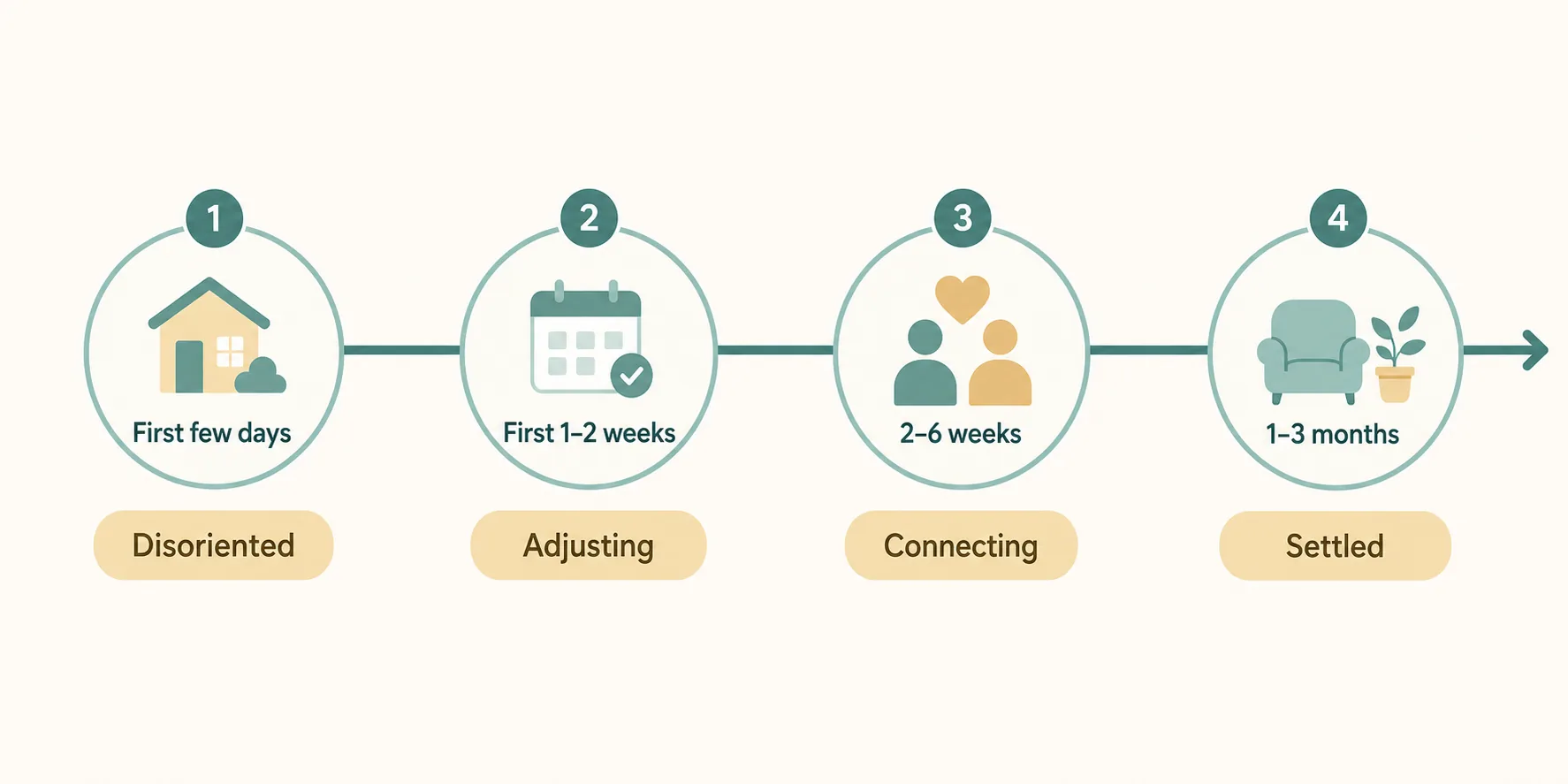
The settling-in period rarely runs in a straight line. Good days and hard days sit side by side for a while, and a dip in week three does not undo the progress of week two.
The First Few Days
The first days are usually the rawest. New surroundings, unfamiliar faces and a changed routine can leave your relative disoriented, tired or upset, and it is common to hear “I want to go home.” Some homes suggest a short pause before your first visit, not to keep you apart, but to give staff space to build early trust and a routine. That advice can feel painful, yet it often helps. A calm, well-planned arrival makes a real difference, which is why it helps to know what to expect when moving into a care home before the day itself.
The First Few Weeks, Building Familiarity
Over the first couple of weeks, small anchors form. Your relative learns a carer’s name, finds a favourite chair, recognises the rhythm of mealtimes. First conversations with other residents happen. Low points are still normal here, and a tearful phone call does not mean the placement is failing. Familiarity is doing its quiet work in the background.
One to Three Months, Feeling at Home
By one to three months, routines are usually internalised. Relationships with staff and other residents deepen, activities become something to look forward to rather than endure, and the home starts to feel like their home rather than a place they are staying. This is the point most families describe as their loved one finally settling in.
A dip in week three does not undo the progress of week two, and a tearful phone call does not mean the placement is failing.
Do Dementia Patients Settle Into Care Homes? (Memory Care Timelines)
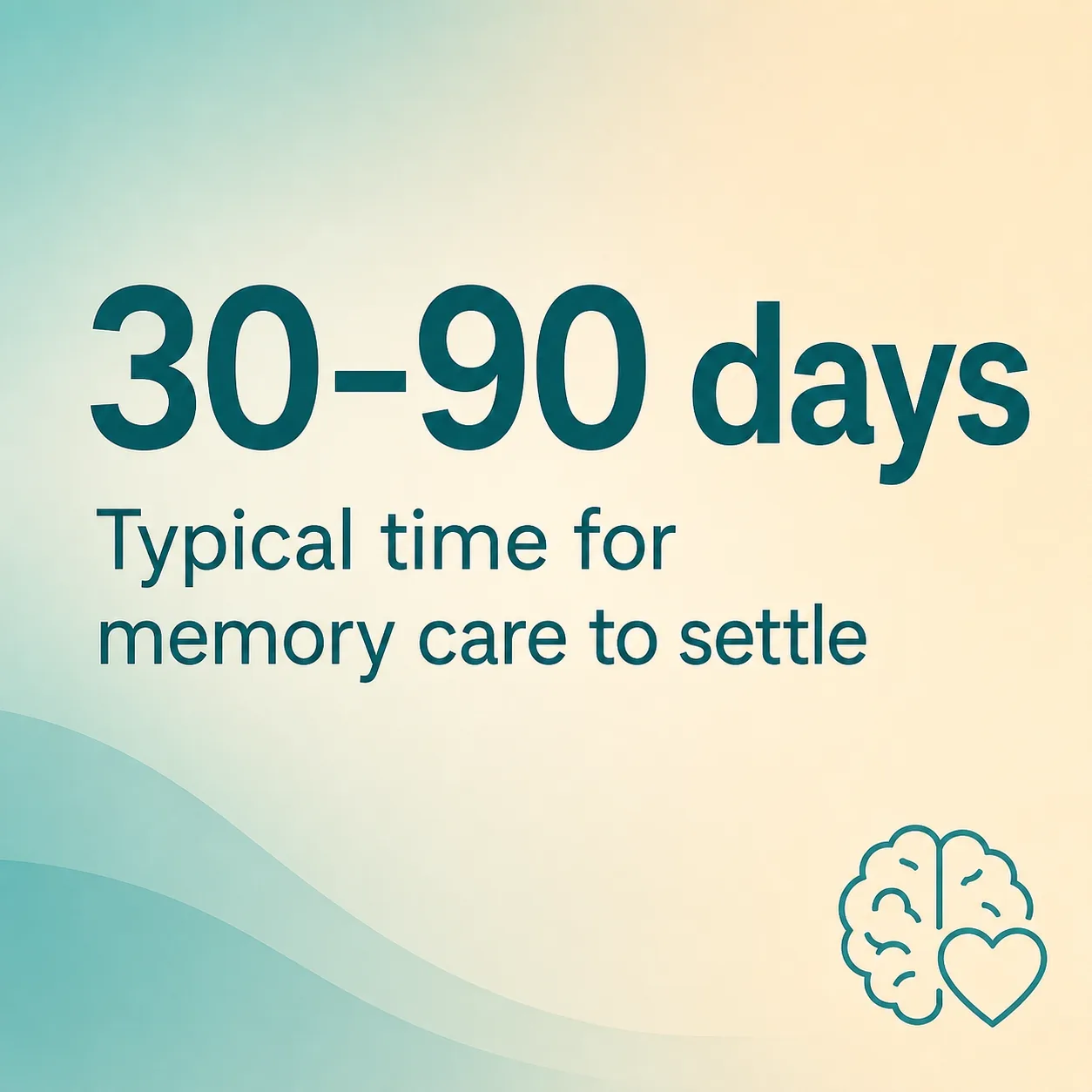
Yes, with the right environment, most people living with dementia do settle, though the timeline is usually longer and less predictable. A common range for memory care is 30 to 90 days, and sometimes more.
The move can trigger relocation stress, sometimes called “transfer trauma”: a temporary rise in confusion, agitation or low mood as a person with memory loss adapts to surroundings they cannot easily commit to memory. It is distressing to witness, but it typically eases as the new routine becomes familiar through repetition. A well-run home with trained staff can provide the continuous, consistent support that becomes harder to deliver at home as the condition advances.
What matters most is consistency: the same faces, a calm environment, a predictable day, and staff trained specifically in memory care. Families navigating this stage often find it reassuring to read practical guidance on moving a parent into a care home with dementia in mind.
What Influences How Long Settling In Takes?
Two people can move into the same home on the same day and settle at very different speeds. Several factors shape the timeline, and the same research on the transition into care points to how personal readiness and the support around a person affect how smoothly it goes.
| Factor | How it affects settling in |
|---|---|
| Cognitive & health stage | Advanced dementia or frailty can lengthen adjustment and change what “settled” looks like |
| Personality & emotional readiness | Sociable, adaptable people often settle faster; private or reluctant movers may need longer |
| Family involvement | Regular, calm contact reassures; over-anxious or absent contact can unsettle |
| Quality of staff & engagement | Warm, consistent, well-trained staff build trust quickly |
| Daily routine & environment | A predictable, homely setting with meaningful activity speeds belonging |
| Reason for the move | A planned move usually settles more smoothly than a sudden, crisis-driven one |
The quality of the setting carries a lot of weight, so it is worth knowing what makes a good care home before and after the move, the same qualities that make a home right to choose are the ones that help a person settle.
How Families Can Help a Loved One Settle In
Families have more influence over the settling-in period than they realise. A few practical steps make a genuine difference:
| What to do | Why it helps |
|---|---|
| Personalise the room | Familiar photos, bedding and objects create instant recognition and comfort |
| Keep visits consistent | A predictable pattern reassures; erratic visits can unsettle |
| Share their life history | Staff who know preferences, routines and stories deliver more personal care |
| Stay calm at goodbyes | A warm, brief goodbye is easier than a drawn-out, tearful one |
| Trust the process | Progress is uneven; a hard day is not a failed placement |
Sharing detailed background is one of the most powerful things you can do, which is why we use a personal life-history and preferences form so staff know the person, not just the patient. And if you feel guilty leaving after a visit, that feeling is almost universal: guilt, relief and sadness often arrive together, and none of them means you did the wrong thing.
When Settling In Isn’t Happening: Red Flags to Watch For
Most early distress is normal and passes. Occasionally it points to something that needs attention, and it helps to tell the two apart.
Normal early signs include tearfulness, wanting to go home, and a few unsettled nights. Genuine warning signs are different: unexplained weight loss; a person becoming withdrawn or fearful over weeks rather than days; poor personal hygiene; unexplained bruises or injuries; or staff who are dismissive of your questions.
If you notice any of these, raise them early and directly. A good home welcomes questions and will work with you, not against you. Being confident about placement in the first place, knowing how to get an elderly person into a care home the right way, makes it far easier to judge later whether concerns are teething problems or real red flags.
Was a Care Home the Right Move? (Reassurance and Alternatives)
Many families keep asking whether they did the right thing long after the move. It usually helps to name what pushed the decision. Three triggers come up again and again: safety and repeated falls; care needs that have grown beyond what home support can safely manage; and carer burnout, where a devoted family member can no longer sustain round-the-clock care.
Reaching that point is not a failure. Exploring alternatives first, home care, assistive technology, respite, is the responsible thing to do, and most families try several before residential care becomes the safest option. If you worry the decision was taken out of your hands, it is worth understanding whether social services can force someone into a care home, because the answer is usually more nuanced and family-led than people fear.
How Long Do People Live in a Care Home? (An Honest, Sensitive Answer)
This is a hard question, and any figure should be read gently, because every person is different. Length of stay varies enormously: some people live in a care home for a few weeks, others for many years. A single average hides that spread and tells you little about any one person.
Where dementia is involved, life expectancy depends heavily on the stage at which someone moves and their overall health, so comparisons between staying at home and moving into care are rarely straightforward. The move often happens when needs are already high, which shapes the picture but says nothing about any one person’s path.
A Brief Note on Cost Worries
While a loved one settles in, money worries often surface at the same time. It is a lot to carry at once. You do not have to solve it all in the first fortnight, start by getting clear on how care home fees work, then look at specific concerns such as how to avoid selling your house to pay for care once you have breathing space to plan properly.
Key Takeaways
| Question | The short answer |
|---|---|
| How long does it take to settle into a care home? | Usually 4-8 weeks to feel comfortable; 1-3 months for full adjustment |
| Does dementia change the timeline? | Yes, commonly 30-90 days, sometimes longer |
| What helps most? | Consistent visits, a personalised room, sharing life history, calm goodbyes |
| What are the warning signs? | Weight loss, withdrawal, poor hygiene, injuries, dismissive staff |
| Is a dip normal? | Yes, progress is uneven, and hard days are part of settling in |
Frequently asked questions
How long does it take to settle into a care home?
Do dementia patients settle in care homes?
How long on average does someone live in a care home?
What three things will push you into a nursing home?
What are the red flags in a care home?
