
This article addresses whether social services can force someone into a care home UK and under what legal conditions. It explores how capacity, best interest, and the Deprivation of Liberty Safeguards (DoLS) determine lawful decisions.
It analyses recent data on DoLS applications, showing that only 19 % were completed within the statutory period in 2024, leaving over 123,000 unresolved cases. The piece also clarifies that, for individuals who retain mental capacity, social services have no authority to compel a move.
It outlines when intervention may be justified, how the legal framework works, and what rights families hold. Readers finish with a full understanding of their legal position, their options for care, and the reassurance that forced moves are rare and heavily regulated.
What are Social Services?
Social services departments operate under local authorities across England and Wales. Their duty is to support older people, adults with disabilities, and vulnerable individuals who need care and support to live safely. The Care Act 2014 establishes how these departments assess needs, provide community care, and arrange residential placements where required.
Most local councils conduct needs assessments to evaluate daily living tasks, mobility, medical support, and safety. The goal is to keep the person at home wherever possible through community programs, live-in care, or home adaptations.
Only when these measures fail or the risk becomes unacceptable does the question of residential care arise. Social services, therefore, function as coordinators, not enforcers, ensuring that interventions remain lawful and proportionate.
What is a Care Home?
A care home is a regulated residence providing accommodation, personal care, and sometimes nursing care to older or vulnerable people. In the UK, the Care Quality Commission (CQC) regulates and inspects these facilities, and understanding what is a CQC rating helps families evaluate the quality and safety of a care home before making a decision.
There are two main categories:
| Type of Care | Description | Typical Resident Needs |
| Residential Care Home | Offers personal care such as washing, dressing, meals, and companionship. | Older adults who are independent but need daily support. |
| Nursing Home | Provides medical supervision with registered nurses on-site. | People with chronic illnesses or high medical needs. |
Oakland Care operates premium facilities like Oakland Court and Oakland Grange, combining professional healthcare with comfort, sustainable design, and community engagement.

Can Social Services Force Someone into a Care Home?
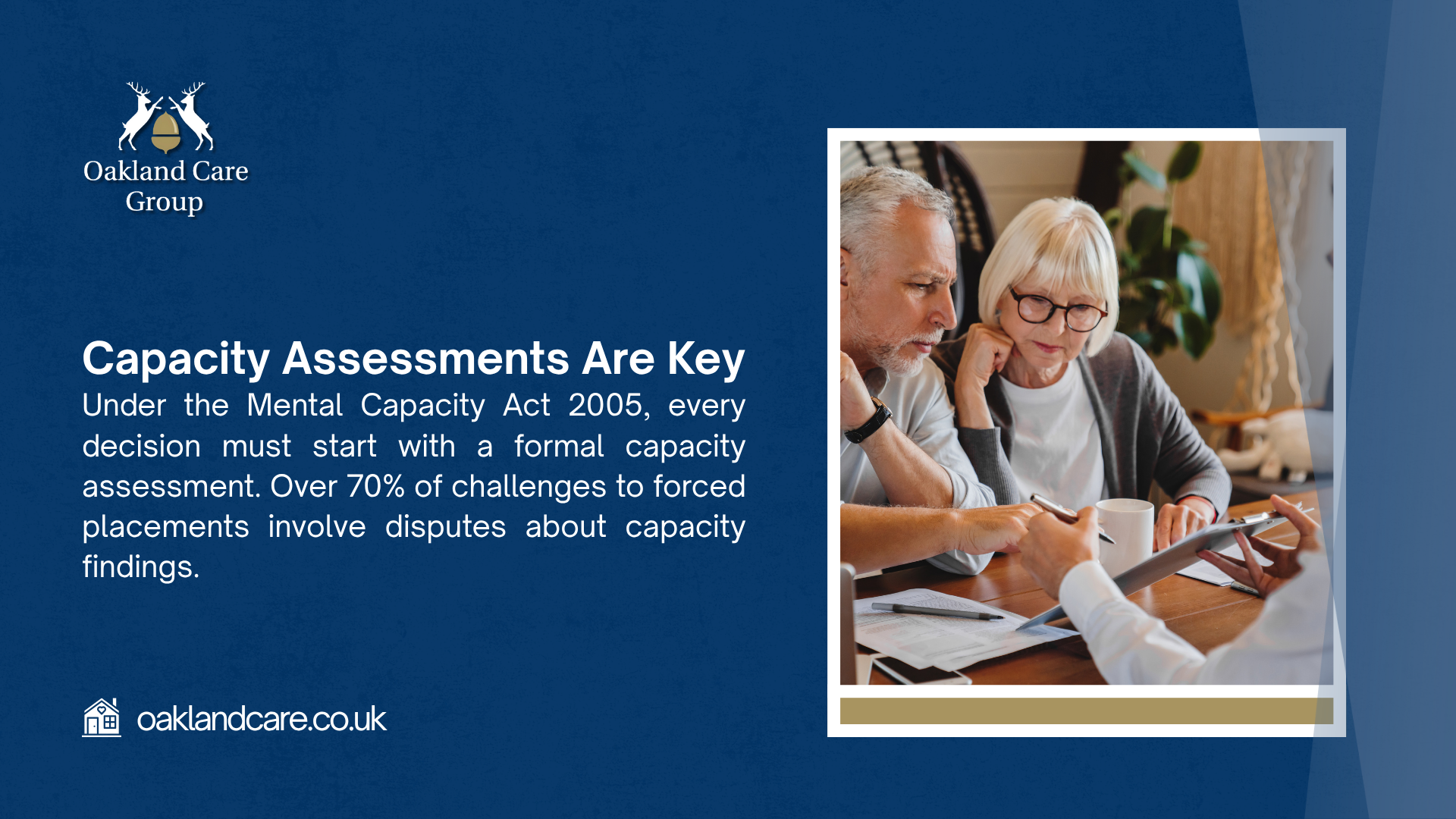
In most situations, no. A person who has mental capacity cannot be forced into a care home. The Mental Capacity Act 2005 protects individual autonomy, meaning that every capable adult can decide where and how they live.
However, the law allows social services to arrange placement without consent only when two strict conditions apply:
- The person lacks the mental capacity to make that decision.
- The placement is authorised under the DoLS or the Court of Protection.
If these safeguards are absent, any forced admission would amount to unlawful detention. The Human Rights Act 1998 further protects liberty (Article 5) and family life (Article 8), both of which restrict public authorities from overreach.
This means social services can recommend, persuade, or fund care, but they cannot compel an individual who understands and refuses. Forced entry into care is therefore exceptional and subject to extensive oversight.
When Can Social Services Take Steps?
Certain circumstances may justify action when personal safety or public welfare is at risk. These are governed by the Care Act 2014, the Mental Capacity Act, and the Mental Health Act.
| Circumstance | Description | Authorisation |
| Lack of Capacity | The person cannot understand or decide about care. | Mental Capacity Act, Best Interest process. |
| Immediate Risk | Self-neglect, malnutrition, or repeated medical emergencies create danger. | Emergency safeguarding order. |
| Mental Health Grounds | Severe mental disorder leading to risk of harm to self or others. | Mental Health Act detention. |
| Court Decision | Family disputes or objections are resolved by the Court of Protection. | Judicial authorisation. |
Even in these cases, councils must first explore options like care at home, assistive technology, or respite care before recommending permanent residential placement.
In 2023-24, DoLS applications reached over 330,000, but only 19 % were completed within 21 days, showing both heavy scrutiny and systemic delay. These figures demonstrate that the system prioritises caution over haste, protecting individual rights.
When to Consider a Care Home?
Deciding on residential care should follow a thorough evaluation rather than a crisis reaction. Indicators include severe mobility decline, worsening dementia, unsafe home environments, or exhaustion of family support. Professionals assess daily living capacity, nutrition, and medical management.
If independence is still viable, social workers are obliged to recommend home support first. Moving into a Care Home and Moving a Parent into a Care Home from Oakland Care provides detailed guidance for families evaluating such transitions.
Ultimately, the decision should reflect dignity and preference rather than compulsion. Proper consultation ensures the person remains central to the process.
Life in Care Homes
Once a person moves into a care home, whether voluntarily or through lawful authorisation, they retain fundamental rights. Each resident must receive respect, privacy, and choice in daily routines.
Oakland Care exemplifies modern, community-focused living across its South-East England homes, where residents experience social interaction, balanced nutrition, and access to medical support. Facilities such as Lambwood Heights and Woodland Grove offer landscaped gardens, fine dining, and wellness programs.
The CQC requires that all care homes maintain person-centered plans reviewed regularly. Families should stay involved through visits, feedback meetings, and online care reports to ensure accountability. A good care home is not a place of confinement but a supportive environment that extends independence safely.
How to Avoid Going to a Care Home Against Your Will?
Avoiding unwanted residential placement begins with understanding one’s legal rights. Any adult with full capacity has the authority to refuse care home admission. Clear documentation, financial preparation, and family cooperation are key safeguards.
| Preventive Measure | Description | Related Resource |
| Power of Attorney | Designates someone trusted to manage health and welfare if capacity is lost. | Respect Form |
| Financial Planning | Clarifies who pays for care and avoids sudden funding crises. | Care Home Fees |
| Asset Protection | Explains legitimate ways to retain property without breaching deprivation rules. | Deprivation of Assets |
| Home-based Care | Provides alternatives such as carers, live-in support, and equipment. | Care Home vs Home Care |
| Legal Advice | Helps contest unlawful moves or challenge capacity decisions. | How to Avoid Selling Your House to Pay for Care |
Proper planning reduces the risk of forced relocation and ensures the right level of care remains under personal control.
Example Scenario Where Forced Placement Becomes Possible
Forced care home admission occurs only after all safeguards are met and the risk remains high. Consider the following detailed illustration.
Before formal proceedings, professionals must establish that every community-based intervention has failed and that remaining at home poses substantial danger to life or health.
| Step | Description | Legal Safeguard |
| Assessment | Health and social care teams conclude that the individual lacks capacity regarding accommodation decisions. | Mental Capacity Act 2005 – Section 2 |
| Consultation | Family members and attorneys express concerns; past lifestyle and beliefs are considered. | MCA, Best Interest Principle |
| Review of Options | Attempts at home care and live-in support fail to secure safety; community risk remains high. | Care Act 2014, Least Restrictive Requirement |
| Decision Meeting | Professionals agree that residential care best meets welfare needs. | MCA Best Interest Meeting |
| Authorisation | Since liberty will be restricted, a DoLS request is submitted and approved by the supervisory body. | DoLS under Schedule A1 MCA |
| Ongoing Review | Placement is monitored, and representatives can appeal to the Court of Protection. | Human Rights Act 1998 & DoLS Code |
This scenario shows that a “forced” move happens only after multidisciplinary evaluation, family involvement, legal authorisation, and continual review. Every action must be justified as proportionate, necessary, and in the person’s best interest.

Final Thoughts and Next Steps
The central issue, can social services force someone into a care home UK, is answered through law rather than opinion. A capable person cannot be compelled. When mental capacity is lost, social services may intervene only after applying the Mental Capacity Act, the Care Act, and the DoLS framework. Each step must prove that no less restrictive solution can keep the individual safe.
Current statistics from the Care Quality Commission show heavy procedural delays: over 123,000 uncompleted DoLS applications by March 2024, demonstrating how rarely immediate enforcement occurs.
For families, this translates into time and legal opportunity to participate in every stage. Maintaining communication with social workers, requesting written assessments, and understanding financial rights all strengthen control.
If residential care ultimately becomes the best outcome, choosing a provider that respects autonomy, such as Oakland Care, ensures the transition is based on care, not coercion.
Providers like Oakland Court and Oakland Grange exemplify how safety, dignity, and comfort can coexist. Families seeking guidance can explore Our Values and Day Care to understand how compassionate support works in practice.
The conclusion is clear: social services cannot simply force someone into a care home. They must follow due process, apply lawful safeguards, and place personal liberty above administrative convenience. Every individual retains the right to live, choose, and be treated with respect.
