
Article Summary: Key Points on Care Home Staff to Resident Ratio UK
- There is no single UK-wide staff-to-resident ratio that applies to every care home. Rules and standards vary by nation and type of service.
- In England, CQC Regulation 18 requires providers to deploy enough suitably skilled staff to meet people’s needs.
- Numbers you see online are not a universal benchmark; check which staff, shift and area they describe.
- Providers should assess staffing against residents’ needs and review arrangements as those needs or circumstances change.
- Skill mix, continuity, training and deployment across the day matter alongside headcount.
- Ask for the actual day and night staffing on the floor or unit relevant to your relative.
Families searching for a care home staff-to-resident ratio often expect one legal figure to apply everywhere. There is no single UK-wide ratio, and requirements differ between nations and service types. This guide explains the staffing rules and standards, what a ratio may leave out, and what to ask when visiting a home.
Is There a Legal Care Home Staff to Resident Ratio in the UK?
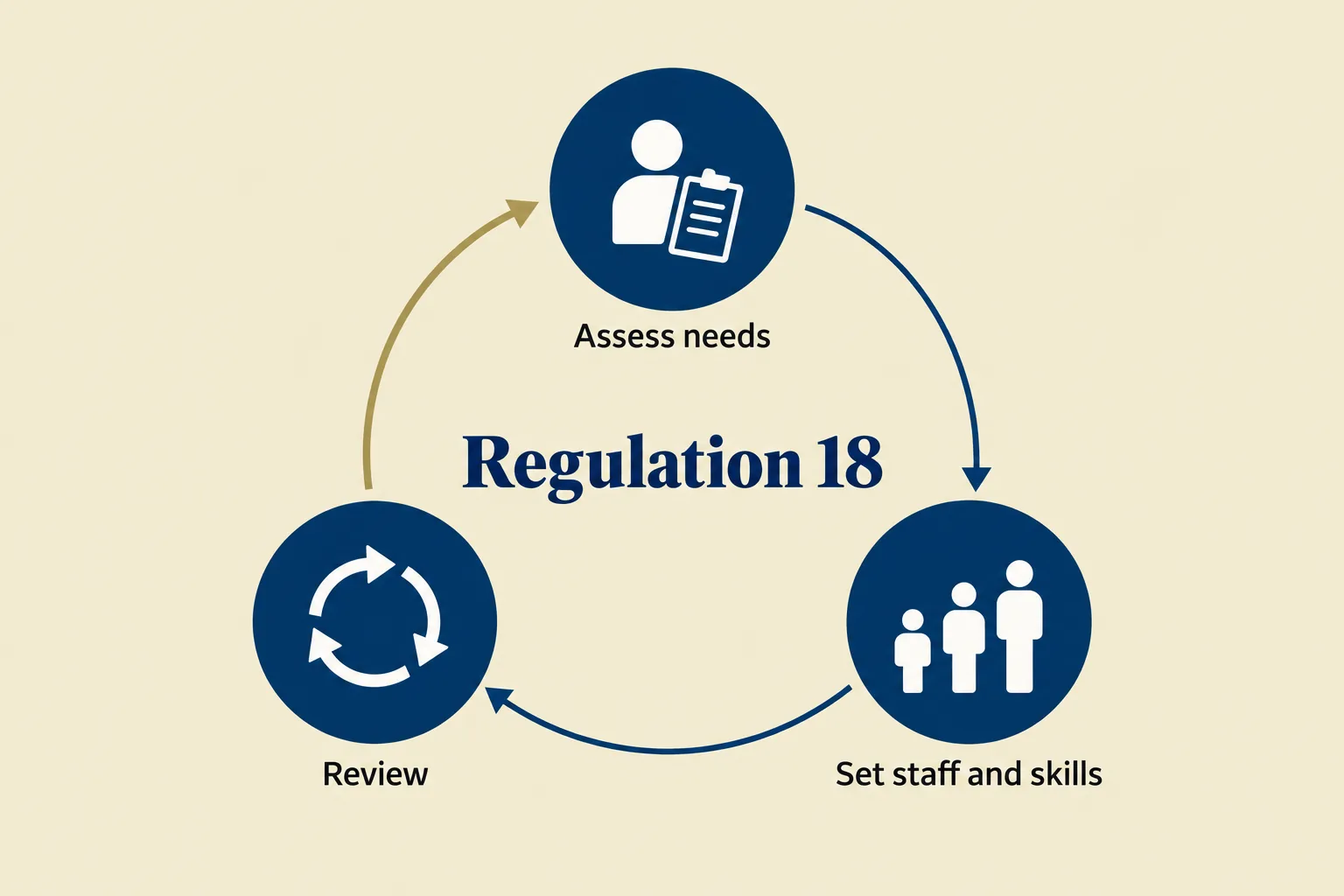
In England, there is no single statutory staff-to-resident number for care homes. Regulation 18 requires providers to deploy sufficient suitably qualified, competent, skilled and experienced staff to meet people’s needs. The CQC’s Regulation 18 guidance says providers should use a systematic approach to determine the numbers and range of skills needed, and review staffing as residents’ needs change. A headcount alone does not show whether the staff on duty have the right skills for the people they support.
Staffing needs can vary with residents’ support needs, the service provided, staff skill mix, shift and layout. A ratio should therefore be treated as one piece of information, not proof that a home is adequately staffed.
Providers should be able to explain how they determine staffing and how the rota reflects residents’ assessed needs. Regulators can consider staffing arrangements alongside records, staff skills and people’s experience of care.
How the Rules Differ Across England, Wales, Scotland and Northern Ireland
The four UK nations regulate staffing separately, so guidance you read about England may not apply where you live.
| Nation | Regulator | Staffing approach | Fixed numeric ratio? |
|---|---|---|---|
| England | Care Quality Commission | Regulation 18 requires sufficient skilled and experienced staff to meet residents’ needs; providers should determine numbers and skill mix systematically. | No single statutory staff-to-resident number |
| Scotland | Care Inspectorate | The Health and Care (Staffing) (Scotland) Act 2019 sets a statutory duty on care-service providers to ensure appropriate staffing. | No single UK-wide ratio; check the Act and service-specific guidance |
| Wales | Care Inspectorate Wales | Regulation 34 of the Welsh 2017 regulations requires sufficient suitably qualified, trained, skilled, competent and experienced staff. Providers must be able to demonstrate how they determine staff types and numbers. | No single UK-wide ratio; service-specific requirements apply |
| Northern Ireland | RQIA | Requirements differ for residential and nursing homes. Check the current RQIA guidance and applicable standards, including the Care Standards for Nursing Homes. | No single UK-wide ratio; category-specific staffing and skill-mix standards may apply |
Typical Staff to Resident Ratios in UK Care Homes
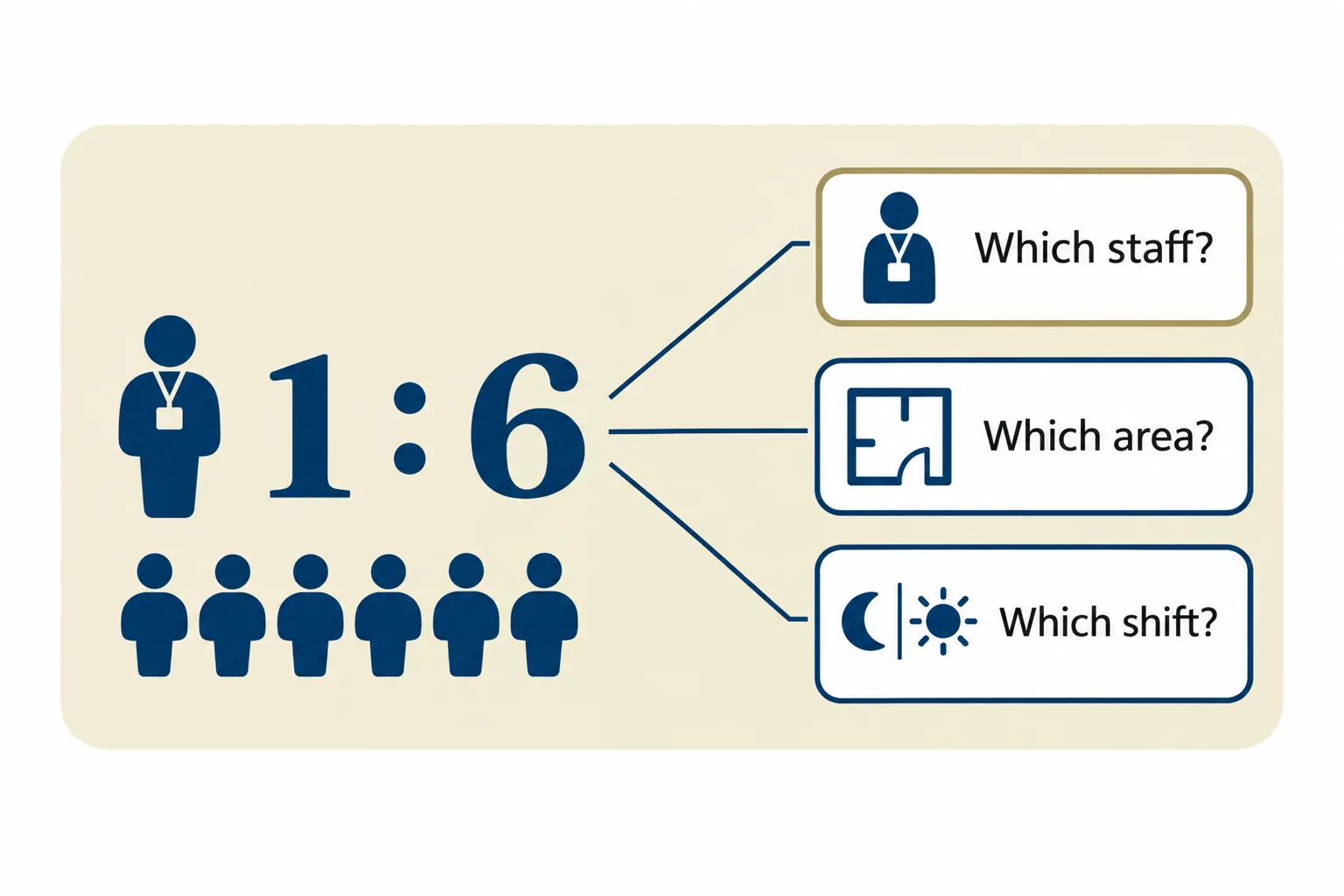
You may see example figures online, such as one care worker for five or six residents. They are not a universal UK benchmark. Before comparing figures, check the nation, type of home, shift, area and staff roles included. Use a ratio as a prompt for questions, not as a pass mark.
| Setting | What really drives the number | Worth asking on a visit |
|---|---|---|
| Residential care | Mobility, continence support and falls risk shape the ratio of staff to residents in a residential home. | How many care staff are on this floor at breakfast and at teatime? |
| Nursing care | Staffing plans may need to account for nursing tasks as well as personal care; ask about the home’s specific service and staffing mix. | How is registered nurse cover arranged across 24 hours? |
| Dementia care | Support needs vary by resident and time of day; ask how the team responds to individual routines and support plans. | How do you staff the times of day when residents are most unsettled? |
Ratios may count different roles, shifts or parts of a home. Ask whether the figure includes care assistants, registered nurses, senior staff and agency workers, and whether it describes the whole home, a floor or a specific shift. Ancillary roles such as catering or housekeeping may be reported separately. Our guide to care homes and nursing homes explains the difference between residential and nursing services.
Before Comparing Staffing Figures
A ratio can describe different things depending on who is counted and when it is measured. Before comparing figures, ask:
- Is this the planned number or the staff actually on duty?
- Does it cover the whole home, one floor or a specific unit?
- Which roles are included, such as care assistants, registered nurses, senior staff or agency workers?
- Which shift or time of day does the figure describe?
How to Assess Staffing at Night
Staffing arrangements can differ overnight because residents’ routines and support needs differ by time of day. Some residents still need help with mobility, personal care, repositioning or reassurance. Ask how the home plans overnight cover for the people who live there.
Ask who is in charge overnight, how many staff are awake and on the floor, how emergencies are escalated, and how the home monitors call-bell response. You can also ask how sleeping-in staff are used, if the home has them.
Assisted Living Ratios Are Not the Same Measure
Extra-care housing and retirement housing with support are different arrangements from registered care homes. Staffing may be organised around care hours or a shared on-site team, depending on the scheme. A care-home staff-to-resident ratio may not be directly comparable. Ask what support is available, when staff are present and how quickly they can respond.
How Care Homes Calculate Safe Staff Levels
Some providers use a dependency assessment or staffing tool to help plan rotas. The method varies, and no single tool should be presented as universal. Factors may include mobility and transfers, personal care, mealtime support, medication needs, cognition, behaviour, falls risks and end-of-life support.
For example, two homes with the same number of residents may need different staffing plans if one has more residents who need hands-on mobility support, while the other has more residents who are independent between planned care visits. The resident count alone does not show the level or type of support required.
Staffing plans should be reviewed when residents’ needs or circumstances change. Ask how often the home reviews its assessment and rota, and what triggers an earlier review.
Factors That Push a Home’s Requirement Up
| Factor | Effect on staff numbers |
|---|---|
| Multi-floor buildings, long corridors, separate households | Layout can affect how staff are deployed and whether teams can respond across different areas. |
| Nursing, dementia and end-of-life care | The support required depends on residents’ individual needs and the service provided. |
| Two-person handling and hoist transfers | Transfers requiring two staff need both workers to be available at that time. |
| Mealtimes and medication rounds | These tasks may affect how staffing is arranged across busy parts of the day. |
Why the Ratio Number Alone Tells You Very Little
Headcount alone does not show continuity or staff familiarity. Ask how the home uses agency and temporary staff, how it maintains handovers, and how staff learn residents’ routines and support plans. Familiarity may be especially relevant for residents who benefit from consistent routines, but it should not be treated as a substitute for adequate staffing.
Ask how staffing changes across the day and how the rota covers busy periods, planned care and residents who need support at particular times. A total headcount does not show how many staff are available on a specific floor or shift.
Ask which staff roles are included in any figure and which are counted separately. Catering, housekeeping and activities teams have different duties from direct-care staff, and the way a provider reports them may vary. Our guide on what to look for when choosing a care home covers other operational questions to ask.
How Staff Levels Affect Care Home Fees
Staffing is one factor in the cost of running a care home, but fees also depend on the service, location and the person’s assessed needs. Ask providers for a written breakdown and clarify what may change if needs increase. Our overview of care home fees explains related cost questions.
Questions to Ask a Care Home About Staff Numbers
These questions can help you understand how the home plans and reviews staffing. Ask for clear explanations and follow up if an answer is unclear.
| Question | Why it matters | What a strong answer sounds like |
|---|---|---|
| How do you assess staffing needs? | Shows how the home links staffing to residents’ needs | A clear explanation of its method, review process and how it responds to changes |
| What are your day and night numbers on this floor today? | Floor-level reality beats home-wide averages | Specific figures, given without hesitation |
| How do you use agency or temporary staff? | Helps you understand continuity and cover | A clear explanation of how temporary staff are briefed and supported |
| How do you monitor staff turnover and continuity? | Gives context about staff stability | A clear explanation of what the home monitors and how it responds |
| How do you monitor call-bell response and follow up delays? | Helps you understand how requests for help are tracked | A clear explanation of the process and how concerns are addressed |
| What is your registered nurse cover overnight? | Clinical needs do not keep office hours | A clear arrangement, explained plainly, including cover for sickness |
Our fuller list of questions to ask when visiting a care home goes deeper into staff training and experience.
What to Watch For on a Visit
Observe how staff interact with residents and whether people receive help when they ask for it. If possible, visit at different times and look at everyday routines such as mealtimes. Ask the home how it responds to delays or concerns. In England, read the staffing information in the latest CQC report as well as the overall rating; elsewhere, check the relevant regulator’s report.
Key Takeaways
Related readingHow Do I Know If a Care Home Is Good? UK Family GuideRead the guide →| Question | Short answer |
|---|---|
| Is there a legal ratio? | There is no single UK-wide staff-to-resident ratio; requirements differ by nation and service type. |
| What does the law require in England? | Enough suitably qualified, competent, skilled and experienced staff to meet residents’ needs |
| Who decides the number? | The provider plans staffing; regulators assess whether arrangements meet requirements |
| What should families check? | Day and night numbers on the specific floor, agency use, turnover and call bell audits |
Ask the home to explain how its staffing plan meets residents’ needs and how it reviews that plan when circumstances change. A ratio by itself cannot answer those questions.
Frequently asked questions
Is there a legal minimum staff-to-resident ratio in UK care homes?
What is a good staff-to-resident ratio for dementia care?
How many staff should a care home have at night?
Does the CQC inspect staff levels?
Are kitchen and activities staff counted in a care-home ratio?
Talk to Our Team at Oakland Care
A visit can help you see how a home works and ask about its staffing arrangements. Oakland Care has two homes in West Sussex: Oakland Court in Felpham and Oakland Grange in Littlehampton. Contact the relevant home to ask about its current services and arrange a visit.
If you are at the start of this process, our guidance on moving into a care home walks through what to expect.