
Quick Answer: Who Inspects Care Homes in the UK?
How are care homes inspected in the UK? The regulator for the country where the home operates inspects and monitors them. There is no single UK-wide care-home inspector: the Care Quality Commission (CQC) regulates England, Care Inspectorate Wales (CIW) regulates Wales, the Care Inspectorate regulates Scotland, and the Regulation and Quality Improvement Authority (RQIA) regulates Northern Ireland. Each regulator has its own standards, assessment process, and report format.
In England, CQC assessments are not limited to a single scheduled visit. CQC uses information from monitoring, feedback, provider information, records, and inspections to assess whether a service is safe, effective, caring, responsive, and well-led.
For Oakland Care, the relevant regulator is the CQC because Oakland Court is in Felpham, near Bognor Regis, and Oakland Grange is in Littlehampton. Check the record for the individual home rather than relying only on the provider or group name.
The Four UK Care Regulators at a Glance
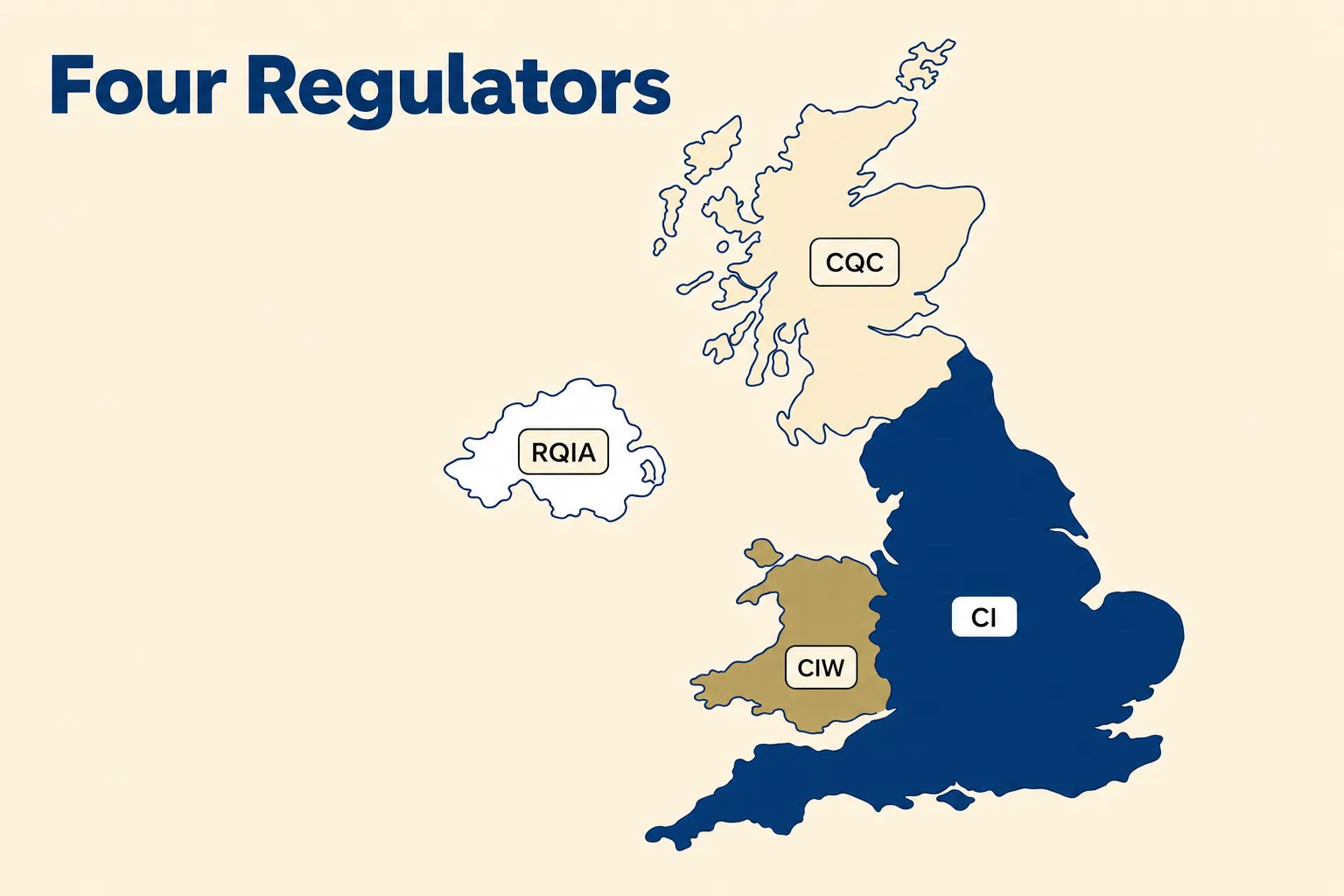
| UK nation | Regulator | Where families can start |
|---|---|---|
| England | Care Quality Commission (CQC) | Search CQC care services by name or location. |
| Wales | Care Inspectorate Wales (CIW) | Read CIW inspection reports. |
| Scotland | Care Inspectorate | Use the Care Inspectorate Scotland website for service information and reports. |
| Northern Ireland | Regulation and Quality Improvement Authority (RQIA) | Search RQIA inspection reports for registered services. |
How Care-Home Registration Works
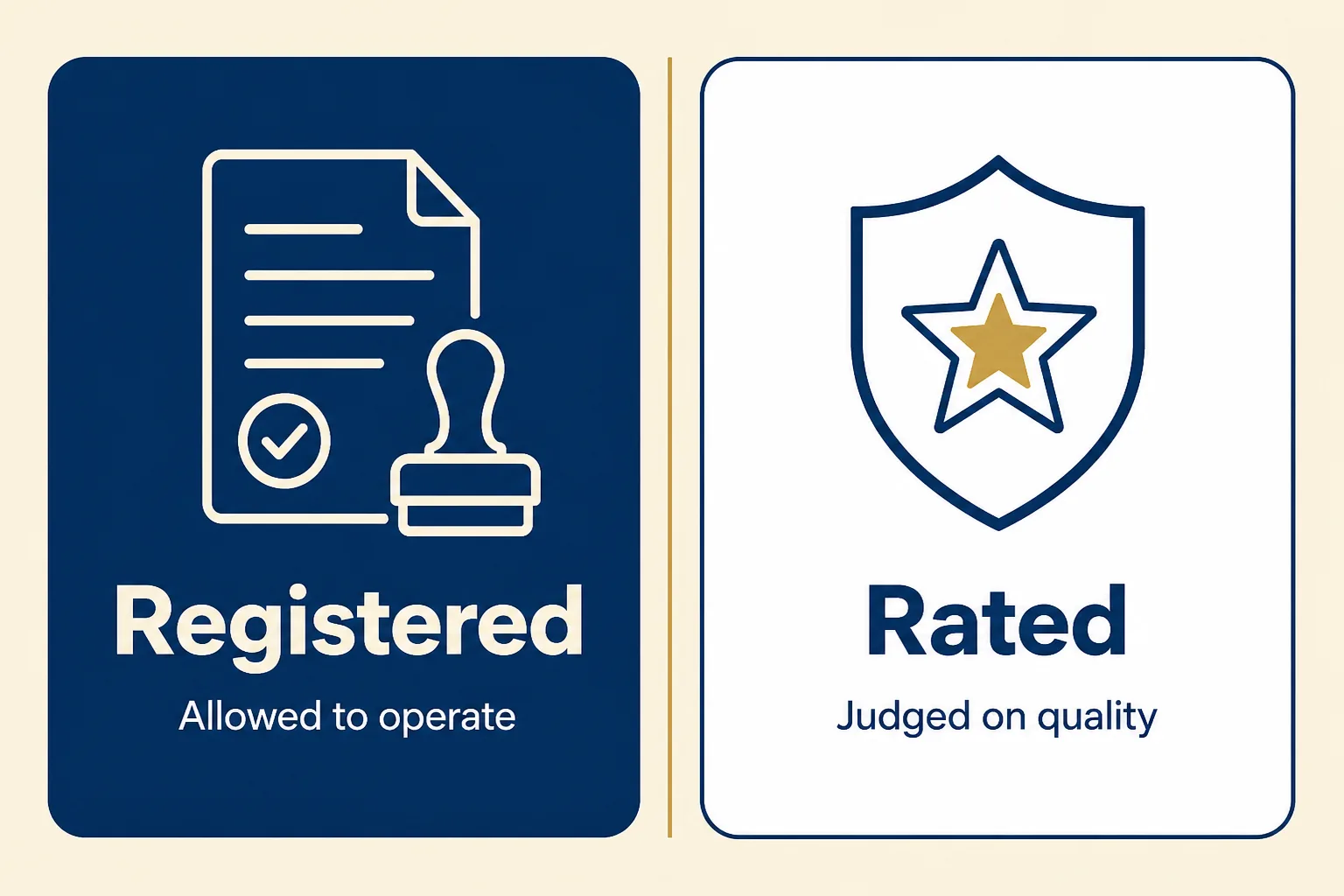
Registration comes before regulated care begins. In England, a person or organisation carrying on a CQC-regulated activity must register with the CQC. The registration record identifies the legal provider, locations and regulated activities. Some providers must also have a registered manager as a condition of registration. CQC explains registration and continuous monitoring here.
This distinction matters when you are comparing homes. Registration confirms that a provider is authorised for the activities recorded for that location; it is not the same as an inspection rating or a guarantee that the home is the right fit for your relative. Wales, Scotland and Northern Ireland have their own registration arrangements under their respective regulators.
How CQC Assessments and Inspections Work in England
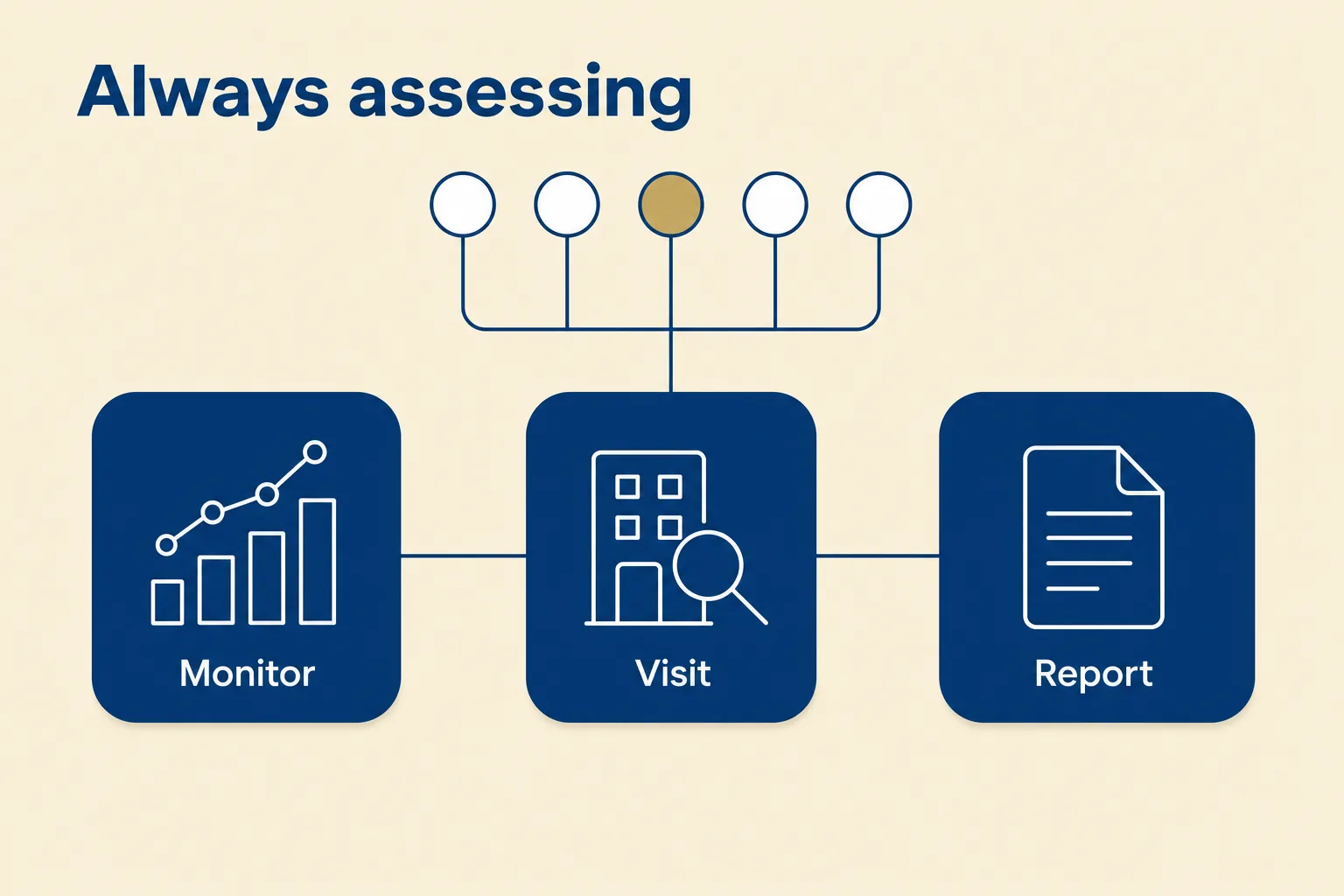
Families often use “inspection” to describe the whole regulatory process. The CQC’s current assessment framework combines information gathered before, during, and between visits. It uses five key questions and quality statements to examine the quality and safety of care. Read the CQC assessment framework.
The Five Questions CQC Uses
The five questions give families a useful structure for reading an English care-home report:
| Question | What it asks |
|---|---|
| Safe | Are people protected from abuse and avoidable harm? |
| Effective | Does care, treatment and support achieve good outcomes and maintain quality of life using appropriate evidence? |
| Caring | Are people treated with compassion, kindness, dignity and respect? |
| Responsive | Is the service organised around people’s needs and preferences? |
| Well-led | Do leadership, management and governance support high-quality, individualised care and learning? |
These questions are not a scorecard that a family can apply without reading the evidence. The findings, examples and any required improvements explain why the regulator reached its judgement. See the CQC’s explanation of the five key questions.
What Evidence Can Inspectors Use?
CQC can draw on information from its ongoing monitoring, previous findings, concerns and feedback, provider information, care records, conversations and what the assessment team observes. This can include speaking with residents, relatives, staff and other professionals, as well as observing care and the environment. CQC explains how assessment teams plan their work.
Who May Be on the CQC Team?
The team’s size and professional mix vary according to the service and the information available. Many teams include CQC inspectors and may include clinicians, pharmacists or Experts by Experience. For a care home, a smaller team, sometimes including one inspector and an Expert by Experience, may be appropriate.
Are CQC Care-Home Visits Announced?
The timing of a visit can vary. Some visits may be unannounced, while others may be announced or arranged at short notice where that is appropriate. Families should not assume that every regulator or every assessment follows the same notice period. The important test is whether the home provides safe, respectful care consistently, not only when a visit is expected.
How the Scope of a CQC Assessment Can Vary
An assessment may examine several key questions or focus on a particular risk, theme, complaint or previous concern. CQC can also carry out follow-up work where an earlier report identified concerns. The timing and scope are informed by risk and available evidence, so there is no useful universal inspection timetable for every English care home.
How Inspections Differ Across the UK Nations
The purpose is shared across all four nations: check the home against national standards, publish what was found, and act where care falls short. The presentation differs. Wales, Scotland and Northern Ireland each publish their own report format and their own labels, and none of them map neatly onto the English ratings. If you are comparing homes across a border, read the findings in the text rather than matching the words on the front page.
How Care Home Ratings Differ Across the UK
The four regulators share a broad purpose: checking that registered care services meet relevant standards and taking action when people may be at risk. However, the wording of standards, inspection methods, report layouts and rating systems differ. A rating or grade in one nation should not be treated as a direct equivalent of a label in another.
| Nation | What families should know |
|---|---|
| England | CQC reports commonly organise findings around safe, effective, caring, responsive and well-led. |
| Wales | CIW publishes inspection reports. Published ratings for care homes and domiciliary support services were introduced from April 2025, so check the current CIW information for the service. |
| Scotland | The Care Inspectorate publishes service information, inspection reports and evaluations through its current Scottish website. |
| Northern Ireland | RQIA publishes inspection reports for registered health and social-care services, including residential and nursing care homes. |
How Care-Home Ratings Differ Across the UK
England: CQC Ratings
Where CQC publishes an overall rating for an English service, the four labels are Outstanding, Good, Requires improvement and Inadequate. Not every service will have a current overall rating, so check the report and location record as well as the headline label. Read the CQC’s current ratings and scores guidance.
Related readingWhat Does CQC Outstanding Mean? Care Home GuideRead the guide →| CQC rating | Plain-English meaning |
|---|---|
| Outstanding | The service is performing exceptionally well. |
| Good | The service is performing well and meeting the expectations set by the regulator. |
| Requires improvement | The service is not performing as well as it should and is told what it must improve. |
| Inadequate | The service is performing badly, and CQC has taken action. |
A rating is a useful starting point, not a substitute for reading the findings or visiting.
Ratings can predate changes in management, staffing, residents’ needs or the physical environment.
For a plain-English explanation of the English scale, see our guide to what a CQC rating means.
Wales, Scotland and Northern Ireland do not use the same four-label CQC scale. Compare the evidence and the regulator’s own explanation within each nation instead of translating every label into “Good” or “Bad”.
What Happens After a Care-Home Inspection?
For an English service, CQC publishes a report setting out its findings, examples of good practice, concerns and any breaches of regulation. The provider may need to respond and produce an action plan explaining how it will improve. CQC can follow up by contacting the provider or carrying out focused inspection work. See how CQC publishes findings and follows up concerns.
When reading a report, look for what the provider was asked to improve, the timescale or follow-up information, and whether later evidence suggests progress. If the report raises a concern relevant to your relative, ask the home to explain what has changed now.
How to Read a Care-Home Inspection Report
A report captures evidence from a defined period. Use it to form better questions, then test those questions during a visit and conversation with the home.
| What to read | Why it matters |
|---|---|
| Report or assessment date | The findings may predate a change in manager, staffing, ownership, building, or residents’ needs. |
| Location and scope | Confirm that you are reading the report for the correct home and understand which areas or key questions were assessed. |
| Evidence and people’s experiences | Look for specific examples, not only the headline rating. |
| Concerns, breaches and required actions | These show what the regulator expected the provider to address. |
| Previous reports and follow-up | Earlier reports can show whether an issue recurs or whether later information shows change. |
| Positive practice | Good findings can help you ask what the home does well and how that would apply to your relative. |
If you are comparing several homes, our guide on how to choose a care home can help you combine regulatory evidence with practical questions about care, location and daily life.
If you need the practical steps for locating a specific English home’s rating, use our guide to checking a care home’s CQC rating.
What an Inspection Report Cannot Tell You
A report cannot fully show the atmosphere of a home, how staff speak to people throughout the day, whether meals suit your relative, or whether the activities and routines feel right for them. It is also not a promise that every future experience will be identical to the period assessed.
Visit at a suitable time, speak with residents and staff where appropriate, observe how people are treated, and ask how the home responds when needs change. A report and a visit answer different questions.
Questions to Ask on a Care-Home Visit
| Question | What a helpful answer should cover |
|---|---|
| When was the latest assessment, and what has changed since then? | A clear explanation of improvements, current priorities, and any relevant follow-up. |
| Which areas of care were assessed? | The report’s scope and how the home monitors areas that were not recently inspected. |
| How are care plans reviewed? | When reviews happen, who contributes, and how preferences or changing needs are recorded. |
| What happens if my relative’s needs change? | The home’s registered services, reassessment process, and options if needs go beyond its scope. |
| How can relatives raise a concern and receive an update? | A named contact, a clear complaints route, and an explanation of how concerns are recorded and followed up. |
The aim is not to find a home with a perfect-looking headline. It is to understand the evidence, ask direct questions and decide whether the home can meet your relative’s needs with dignity and consistency.
Frequently asked questions
How often are care homes inspected in the UK?
Where can I find a care home’s latest inspection report?
What if a care home does not show a current overall rating?
Can families share feedback with a care regulator?
Do all UK nations use the same care-home ratings?
Considering Oakland Care?
If Oakland Care is on your shortlist, explore Oakland Court in Felpham and Oakland Grange in Littlehampton. Check the registered services and current availability for the individual home, then arrange a visit so you can discuss your relative’s needs with the team. For further preparation before you visit, explore Oakland Care’s advice for families.