
Families comparing assisted living with a care home may be planning ahead or responding to a change in a relative’s support needs. The right option depends on the person and on what each setting can provide. This guide explains the differences and the questions to ask before deciding.
Article Summary: Assisted Living vs Care Home UK at a Glance
- Assisted living or extra-care housing usually means a self-contained home with support available; facilities, staffing and how care is arranged vary by scheme.
- A care home generally provides accommodation and personal care together; check the provider’s contract to see exactly what the fee includes and what costs extra.
- There is no single dividing line based on age or diagnosis. Suitability depends on assessed needs and the support each provider can deliver.
- Costs are structured differently, but the total depends on housing, service charges, care hours, and any extras. Compare written breakdowns.
- Regulation differs too, which matters for inspection reports, complaints and safeguarding.
- Below: care levels, independence, daily life, regulation, cost, funding, who qualifies, home care as a third route, and how to choose.
What Assisted Living Means in the UK
In the UK, “assisted living” is often used for extra-care housing, also called housing with care or very sheltered housing. People usually live in a self-contained flat, while on-site support and facilities vary. Services may include meals, personal care or domestic help; check whether support is provided by the housing scheme or a separate care provider. Ask about tenure, staffing, emergency response, care charges and what happens if needs change. The NHS overview of housing options for older people explains how extra-care housing can differ from sheltered housing.
What a Care Home Means in the UK
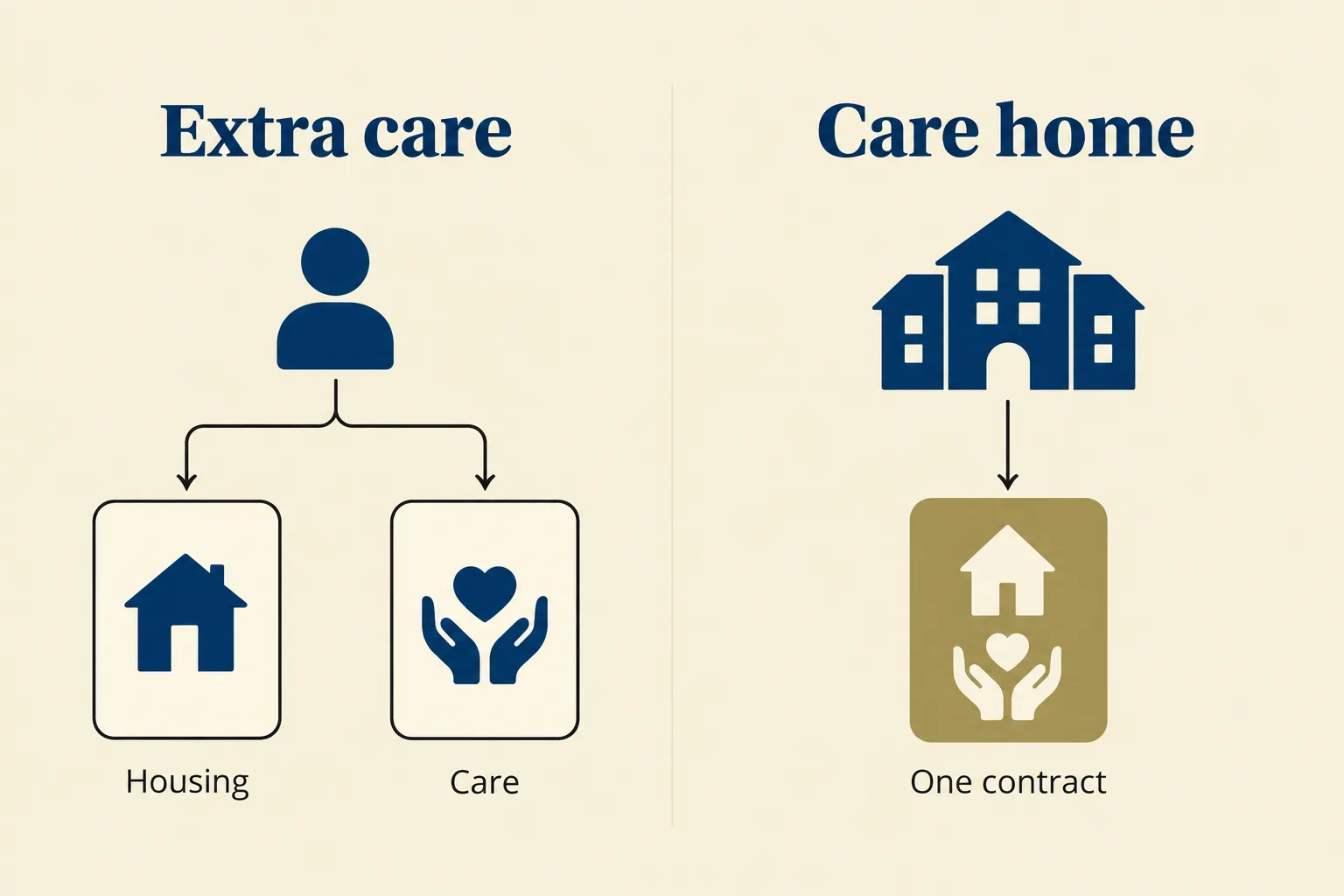
A care home provides accommodation with personal care as part of the service. Meals, laundry, housekeeping, activities and other services may be included, but the contract should set out any extras. Residential care supports day-to-day personal needs; a nursing home also provides nursing care. The staffing model and services differ by home, so ask who is on site and when. Some homes offer dementia support or respite stays, subject to their provision and availability. Care plans should reflect the resident’s needs and be reviewed as appropriate. For a closer look at the distinction, read our guide to a care home and a nursing home.
Side-by-Side Comparison: Assisted Living vs Care Home
| Feature | Assisted living / extra care | Care home |
|---|---|---|
| What you hold | Tenure varies; check the lease, tenancy or purchase terms | A contract with the care provider |
| Typical resident | May manage independently between agreed support | May need personal care available throughout the day or night |
| Staff on site | Depends on the scheme; ask about response arrangements | Ask about staffing, including overnight cover |
| Meals | May be available; check what is included | Check meal provision and any related charges |
| Personal care | May be arranged separately or through the scheme | Usually provided as part of the care-home service; check contract |
| Night support | Ask what response and planned care are available | Ask what overnight support the home provides |
| Dementia | Depends on the scheme and support available | Confirm dementia experience and suitability with the home |
| Admin load | Responsibilities depend on the housing and care contracts | Accommodation and care are generally arranged through the home |
| Cost shape | Housing costs, service charges and care charges may be separate | One fee may cover several services; check extras |
| When needs rise | Ask how support can change and when a move may be needed | Ask whether the home can meet changed needs |
The practical differences are often about how housing and care are organised, what support is available, and who is responsible for each part. Check the specific scheme and care-home contracts rather than relying on the label.
Care, Support and Independence: What Changes

Some extra-care schemes may suit people who want their own home and can use support arranged around them. A care home may be more appropriate when a person needs frequent or coordinated help. Neither option is right for everyone with a particular diagnosis or support need: ask providers whether they can meet the person’s needs safely, including overnight.
A care needs assessment can help clarify what support someone may need; it does not automatically decide which housing setting is right.
You can request a needs assessment through the local council. Ask each scheme or home how it handles changing needs, what support it can provide and when a move might be needed. Our guide on how to choose a care home in the UK offers further questions for comparing providers.
Daily Life, Accommodation and Family Visits
In extra-care housing, residents may have their own front door and furniture, subject to the scheme’s arrangements. Check its policy on pets, visitors and couples. In a care home, residents can often personalise their room, while shared spaces and activities vary by home. Ask to see the accommodation and a typical activity schedule.
Ask each provider how visits, family involvement and care-plan discussions work. Some care homes may be able to accommodate couples, but this depends on room availability and whether the home can meet each person’s needs.
Regulation: Who Regulates the Care and Housing?
In England, care homes providing regulated activities must be registered with the Care Quality Commission (CQC). Extra-care housing can be structured differently: the housing and personal-care services may be separate, and the care provider may need CQC registration for the regulated activity it provides. The CQC explains the scope of registration for accommodation with nursing or personal care. Check the registration of the actual care provider and understand who is responsible for the accommodation.
Ask for the relevant provider’s registration details and latest inspection information, and confirm how to raise a concern or complaint. Regulation differs across the UK, so check the relevant regulator for the nation where the service is based.
Cost: How the Two Structures Differ
Costs vary widely by region, by the size of the property and by how many care hours a person uses, so ask every provider for a written breakdown before you compare anything.
Related readingWhat to Look for When Choosing a Care Home: A Complete Guide (2026)Read the guide →| Cost item | Assisted living | Residential care home | Nursing home |
|---|---|---|---|
| Main charge | Rent or purchase costs, depending on tenure | Usually a weekly care-home fee | Usually a weekly care-home fee |
| Also payable | Service charge, care hours, utilities, food or other charges may apply | Ask about personal extras and fee reviews | Ask about personal extras and fee reviews |
| Usually included | Depends on the scheme and contract | Check which accommodation, meals and care are included | Check which accommodation, meals, personal care and nursing are included |
| Watch for | Service-charge changes, care costs and any exit or transfer fees | Fee review dates, extras and notice terms | Fee review dates, extras and any NHS-funded nursing-care arrangements |
| Effect of rising needs | Ask how extra support affects charges | Ask how changes in needs affect suitability and fees | Ask how changes in needs affect suitability and fees |
There is no reliable cost comparison without looking at the full package. Compare housing costs, service charges, care hours, meals, utilities, support overnight and any care-home extras using written estimates. Our guide to care home fees explains some of the charges families may encounter.
Who Pays: Means Tests, Pensions and Benefits
A local authority may carry out a financial assessment to work out whether someone must contribute to eligible care costs. The rules and treatment of income, savings and property depend on the type of care and the UK nation. Check current guidance with the relevant council before making financial or property decisions.
Pensions and benefits can be treated differently depending on a person’s circumstances and how their care is funded. Ask the local authority or a qualified benefits adviser how a move may affect the person’s income and entitlements.
If you are considering giving away or transferring assets, get independent legal and financial advice first. A local authority may consider whether assets were deliberately disposed of to reduce care charges. Read our guidance on deprivation of assets and avoiding care-home fees, and see our article on who is responsible for care-home fees for a related question.
Who Can Live in Extra-Care Housing?
Eligibility depends on the individual scheme. It may consider age, housing circumstances, support needs and whether the available service can meet those needs. Council-arranged and privately run schemes can have different application processes, so ask the provider or local council about its criteria.
Ask what support the scheme can provide if needs change, including help overnight, mobility support and dementia-related support. Each care home also assesses whether it can meet a person’s needs; do not assume that a particular diagnosis automatically rules someone in or out.
Questions to Ask Before Choosing
Use the same questions with each scheme or care home so you can compare the actual offer:
- Who provides personal care, and is that organisation separate from the housing provider?
- What is included in the weekly or monthly price, and what is charged separately?
- What support is available overnight, and how quickly can staff respond?
- Can support increase if needs change, and what circumstances could mean a move is needed?
- How are complaints handled, and which regulator oversees the care service?
- Can you review the contract, fee terms and care plan before making a decision?
Home Care as a Third Option
Visiting home care can support someone to remain in familiar surroundings, but suitability and total cost depend on the hours and type of support required, home adaptations and the availability of informal help. Extra-care housing is another option to explore, but support and facilities vary by scheme. Our comparison of care home and home care outlines questions to consider.
How to Decide Between Assisted Living and a Care Home
| If this is a concern or preference | Options to explore |
|---|---|
| Wants more company while remaining in own accommodation | Ask about extra-care schemes, activities and other local support |
| Manages with prompts and planned care visits | Compare extra care, home care and the person’s current support |
| Falls or calls for help at night | Arrange a timely needs and safety review; ask providers about overnight support |
| Missed medication, weight loss or unsafe cooking | Seek advice about the underlying needs and available support |
| Memory loss raises safety concerns | Ask for an assessment and discuss which services can provide suitable support |
| Support is needed after a hospital stay | Ask the discharge team about options, including short-term support or respite if available |
On a visit, ask about overnight staffing, how support can change, care-plan reviews, notice periods, fee reviews and family communication. A respite stay may give someone a chance to experience a home, if a suitable place is available and the provider can meet their needs. For practical next steps, see our guide to moving a parent into a care home.
Key Takeaways
| Point | What to remember |
|---|---|
| Definition | Extra-care housing and care homes arrange housing and support differently; compare the actual services and contracts |
| Suitability | Consider the person’s assessed needs and the support each provider can deliver |
| Cost | Compare the full written cost breakdown, including extras |
| Regulator | Check the registration of whoever delivers the hands-on care |
| First step | Consider a needs assessment and seek independent advice before major property decisions |
Frequently asked questions
Is assisted living cheaper than a care home?
How much does assisted living cost per month in the UK?
Do you lose your pension or benefits when you move into a care home?
What does assisted living include?
Does a care needs assessment decide whether someone should move to a care home?
Is assisted living the same as extra-care housing in the UK?
Is residential care the same as assisted living?
Does CQC regulate assisted-living accommodation?
Can a person with dementia live in extra-care housing?
Can a couple stay together in either setting?
Talk to Oakland Care About the Right Level of Support
If you are considering residential care in West Sussex, Oakland Care has two homes: Oakland Court in Felpham and Oakland Grange in Littlehampton.