
Quick Answer: Find the Correct CQC Record
Use the CQC’s public care-service search to find the exact care home by name, town, city, or postcode. Open the correct location record, select its full details, then read the latest report and the “All inspection reports and timeline” section. Check the report date, the five key-question ratings, the supporting evidence and any required actions before arranging a visit.
When a care decision is urgent, the CQC website gives families a free starting point. For Oakland Care families, this means checking the separate CQC records for Oakland Court in Felpham and Oakland Grange in Littlehampton, rather than searching only for the group name.
| What you want to know | Where it sits | Cost |
|---|---|---|
| The current rating | The care home’s CQC location page | Free |
| The latest report | The latest assessment or inspection report linked from that page | Free |
| Previous reports | The “All inspection reports and timeline” section | Free |
| How judgements are reached | CQC’s assessment and ratings guidance | Free |
What the CQC Is and Why Its Reports Matter
The Care Quality Commission (CQC) is England’s independent regulator of health and adult social care. It publishes reports about the services it assesses, including the evidence behind its judgements, concerns it identifies and any breaches or required improvements. CQC explains how it publishes inspection and assessment findings.
A care home providing regulated activities must be registered with CQC. Its public location record is the best starting point because it connects the home’s name and address with its ratings, reports, registration details and responsible provider.
CQC regulates services in England only. Families in Scotland can use the Care Inspectorate, families in Wales can use Care Inspectorate Wales, and families in Northern Ireland can use the Regulation and Quality Improvement Authority.
How to Find a Care Home’s CQC Report Online
| Step | What to do | Why it matters |
|---|---|---|
| 1 | Open CQC’s Find care services search and select care homes. | The regulator’s directory is the primary source for current reports and ratings. |
| 2 | Search by the care home’s name and add its town, city, or postcode. | A location helps separate homes with similar names. |
| 3 | Match the exact home name, address and postcode in the results. | A provider may operate several locations, and each location has its own record. |
| 4 | Open the result and select the full details or location record. | This is where the home’s ratings, reports, and registration information are displayed. |
| 5 | Open the latest report, then check the previous reports and timeline. | The latest report shows the current published evidence, while the timeline shows whether concerns were isolated or repeated. |
A brand search may take you to a provider record rather than the location record for the individual home. Match the address before reading the rating. If you want a shorter rating-focused walkthrough, see Oakland Care’s guide to checking a care-home CQC rating.
How to Check a Care Home’s Previous CQC Reports
On the location page, open “All inspection reports and timeline”. Compare the dates, ratings and findings across the available reports. A change from Requires improvement to Good may indicate progress, while the same concern appearing in more than one report deserves a direct question.
CQC’s current approach uses assessments and evidence from different sources, so do not assume that every published report covers the service in the same way. Read what the latest assessment considered, how recent it is, and whether it led to any required action.
CQC Rating vs CQC Report: What Is the Difference?
A CQC rating is the headline judgement for a service or key question. The report is the supporting record that explains how CQC reached that judgement. It may include observations, people’s experiences, documents reviewed, strengths, concerns, breaches, and actions the provider must take.
A rating can help you shortlist a home, but the written evidence is more useful when you are deciding what to ask during a visit.
What the CQC Ratings Mean
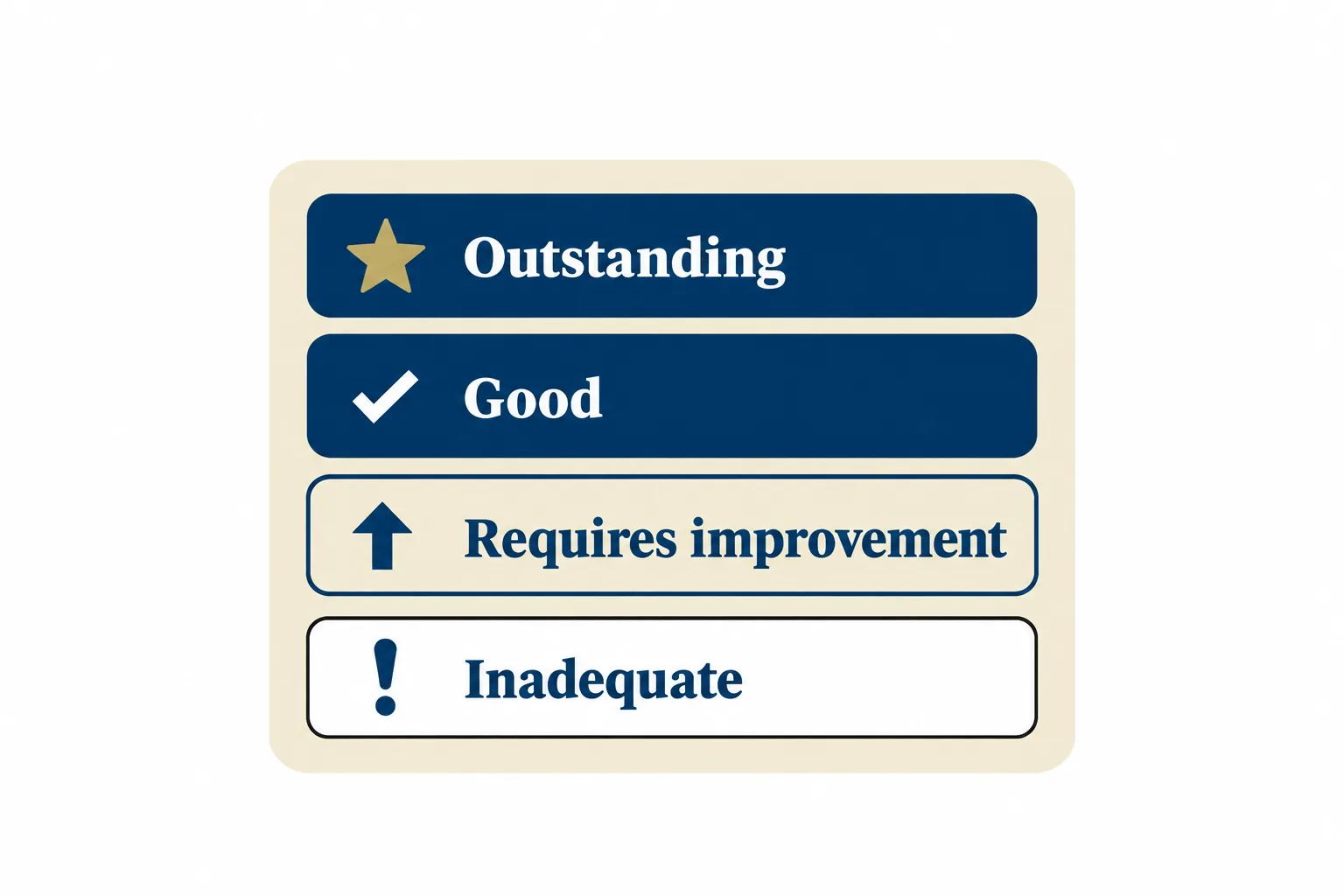
CQC uses four overall ratings: Outstanding, Good, Requires improvement and Inadequate. The regulator’s current ratings and scores guidance explains that some newer assessment reports also include percentage scores, while older reports may show ratings without a percentage.
| Rating | What it means in plain English | Sensible next step |
|---|---|---|
| Outstanding | The service is performing exceptionally well. | Read the evidence and ask how the service maintains that standard. |
| Good | The service is performing well and meeting CQC’s expectations. | Read the key-question ratings and supporting evidence rather than stopping at the headline. |
| Requires improvement | The service is not performing as well as it should, and CQC has identified how it must improve. | Ask what has changed, what action was required and whether CQC followed up. |
| Inadequate | The service is performing badly, and CQC has taken action against the provider or responsible organisation. | Seek an explanation, check for newer information and consider other homes carefully. |
If a newer report shows a percentage score, CQC currently maps 88–100% to Outstanding, 63–87% to Good, 39–62% to Requires improvement and 38% or below to Inadequate. Not every report includes this score.
Do not treat the overall rating as a simple average. Read the five key-question ratings and the evidence beneath them to see where the service is strong and where it needs to improve. Oakland Care’s guide to what CQC ratings tell you provides additional explanation of the rating categories.
What the Five CQC Key Questions Mean in a Care Home Report
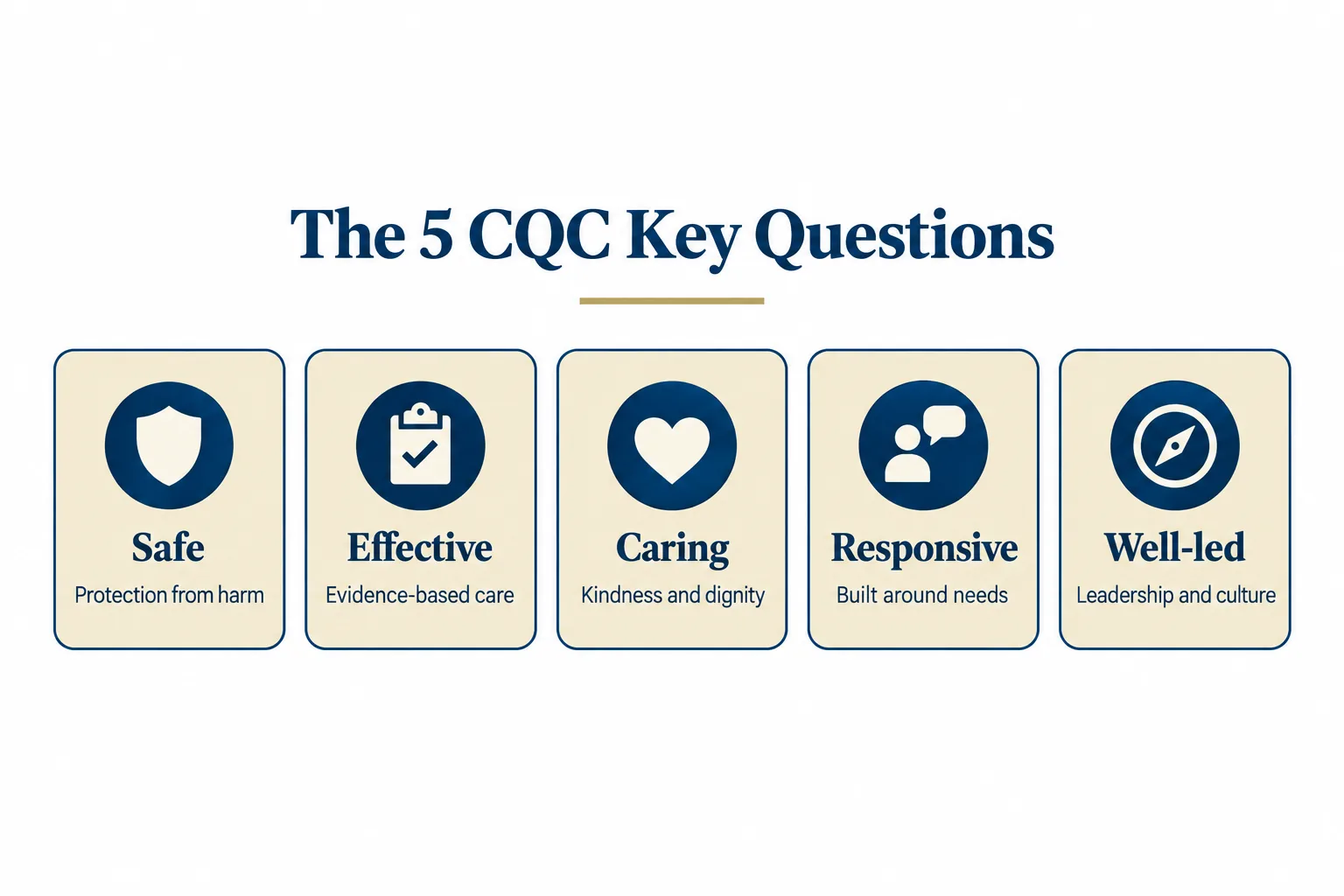
People often search for the “five CQC requirements”, but CQC calls them the five key questions. Its official explanation of the five key questions describes the framework used to assess services. Quality statements sit beneath the questions and explain what high-quality, person-centred care should look like.
Related readingWhat Does CQC Outstanding Mean? Care Home GuideRead the guide →| Key question | What to look for in a care-home report |
|---|---|
| Safe | Protection from abuse and avoidable harm, safe medicines practice, safeguarding, risk management and suitable staffing. |
| Effective | Care, treatment and support based on appropriate evidence, consent, nutrition and people’s health needs. |
| Caring | Compassion, kindness, dignity, privacy and respect for each resident as an individual. |
| Responsive | Care organised around people’s needs, preferences, communication, activities and complaints. |
| Well-led | Leadership, governance, learning, improvement and an open culture focused on people’s needs. |
Each key question has its own rating. If one area is weaker than the overall result, read the evidence and any required improvement action before deciding what to ask the manager.
How to Read the Evidence in a CQC Report
A CQC report usually includes a summary, ratings information, evidence under the key questions, and details of any concerns, breaches or required actions. Start with the summary, then read the evidence sections so you understand why the rating was given.
Look for specific examples rather than relying on general praise. Pay attention to evidence about care planning, medicines, safeguarding, staffing, dignity, activities, complaints and how managers respond when something goes wrong. Quotes from residents and relatives can add useful context, but consider them alongside the wider evidence.
Separate a single administrative issue from a concern that appears repeatedly. If the report identifies an action plan, requirement notice, enforcement action or follow-up assessment, record what the provider was expected to improve and whether later information shows progress. If the headline rating is Good, Oakland Care’s guide to what a Good CQC rating means in practice can help you interpret the result without treating it as a guarantee.
What to Record Before You Visit a Care Home
Use the report to create a short, practical question list. Record the following before you arrange or attend a visit:
| Record this | Why it matters |
|---|---|
| The assessment date and report publication date | Shows how recent the evidence is and whether the report may need to be read alongside newer information. |
| The overall rating and each key-question rating | Shows the headline result and any area that needs closer attention. |
| Examples of good practice or concern | Gives you specific points to discuss with the manager. |
| Breaches, requirement notices or required actions | Shows whether CQC identified a regulatory shortfall and what the provider had to do. |
| Follow-up reports or later updates | Helps you see whether identified concerns were addressed. |
| The registered provider and manager | Confirms that you have the correct location record and current responsible organisation. |
| The listed services and specialisms | Helps you ask whether the home can meet your relative’s current and likely future needs. |
How CQC Assesses Care Homes Between Published Reports
CQC’s current assessment framework allows evidence to be gathered from different sources, including information collected on site and off site, provider information, statutory notifications and feedback from people who use the service.
This means a published report is important, but it is not the only possible source of regulatory information. Check the date, read the latest available material and ask the home to explain any changes since the assessment.
What a CQC Report Cannot Tell You
A CQC report records the evidence considered for that assessment; it is not a live view of every shift. It cannot show exactly who is working today, how the lounge feels at a particular time, or whether the food suits your relative’s preferences. It may also not tell you the current fee, room availability, or cultural fit.
| Source | What it can tell you |
|---|---|
| The CQC report and timeline | Regulatory evidence, published ratings, findings, breaches, and the direction of change. |
| A visit at a normal busy time | The atmosphere, staff manner, routines, cleanliness and how residents spend their day. |
| Conversations with current residents’ families | Day-to-day communication and whether the written promises match lived experience. |
| A direct enquiry to the home | Current suitability, fees, availability, assessment requirements and what support is available. |
Check the location page’s registration details and listed services or specialisms, then ask the home whether it can meet your relative’s needs. Do not assume that a group’s general marketing list applies to every location.
Use the Report to Plan Your Visit
Take the report’s findings with you and turn them into specific questions:
| If the report mentions | Ask the care-home manager |
|---|---|
| Staffing or continuity | How are staffing levels matched to residents’ changing needs, and how is continuity supported? |
| Medicines, incidents or safeguarding | What checks are now in place, and how are concerns recorded and reviewed? |
| Care planning | How will my relative and family be involved when the care plan changes? |
| Complaints or communication | How can families raise concerns, and how will the home update us about the outcome? |
| An older report or a required improvement | What has changed since the assessment, and what evidence can you share during the visit? |
If possible, visit when you can observe everyday routines, such as a meal or activity. The purpose is not to confirm or reject the CQC rating in one afternoon, but to compare the report with the home’s current environment and the answers you receive.
Frequently asked questions
How do I find a care home’s latest and previous CQC reports?
How often are care homes assessed by CQC?
What does it mean if a care home has no CQC rating?
Can I complain or give feedback to the CQC about a care home?
Does CQC rate care homes outside England?
Discuss Your Questions With Oakland Care
If you are considering Oakland Care, families can arrange a visit to Oakland Court in Felpham or Oakland Grange in Littlehampton. Use the CQC report to prepare questions about residential care, respite stays and the services available at the specific home. Contact the relevant home to discuss suitability and current availability, or explore Oakland’s advice hub for families for further guidance.